

License A & C-42 #458947

Originally published: August 2026

A Fallbrook homeowner contacted Lanik Septic Service about three problems on one aging tank: deteriorated access lids, lids buried too deep to reach without excavation, and damage to the interior wall dividing the tank’s two compartments.
Following a full inspection, the recommended plan called for replacing the failing covers, extending both access openings to grade with watertight risers, and restoring the partition that prevents solids from entering the drain field.
For anyone weighing Fallbrook septic repairs, this project shows why bundling related work into a single visit protects both the system and the budget.
Fallbrook developed around large residential lots outside municipal sewer service, which means a substantial share of homes here depend on individual onsite wastewater treatment systems.
Many were installed decades ago and have performed exactly as engineered — but lids, access openings, baffles, and partitions all deteriorate on their own timeline, and most of that deterioration happens where nobody can see it.
The initial request described three concerns: new lids were needed, the existing lids sat too far below grade for practical maintenance, and the interior wall between the tank’s two compartments required repair.
Read together, those are not three unrelated complaints. They are one aging tank telling you three different things at once, which is why a complete inspection had to come before any quote.
If you’re ready to get started, call us now!
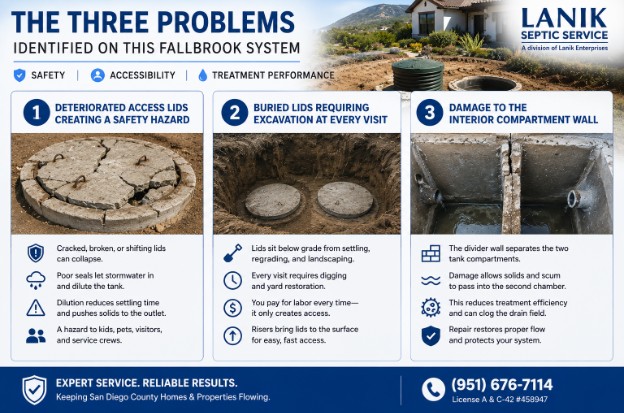
Each issue affects a different dimension of the system — safety, accessibility, and treatment performance.
Septic tank lids do two jobs. They prevent people and animals from falling into the tank and keep surface water and debris out of the wastewater stream.
Concrete covers crack with age, soil movement, root pressure, vehicle traffic, and repeated removal during septic tank pumping visits.
Homeowners typically notice cracked concrete, broken corners, a cover that shifts underfoot, exposed rusting reinforcement, or water draining around the lid edge.
None of those conditions stabilize on their own — deterioration compounds, and a lid that has lost its load rating becomes a hazard to children, pets, visitors, and service crews.
There is a second, quieter cost. A lid that no longer seats properly lets stormwater into the tank. Dilution shortens settling time, and shortened settling time pushes solids toward the outlet — which is precisely the failure the tank’s internal partition exists to prevent.
This was the homeowner’s stated priority: stop digging every time the tank needs attention.
Older Fallbrook tanks were installed with lids sitting several inches — sometimes several feet — below finished grade, and decades of settling, regrading, and new landscaping bury them further.
Every maintenance visit then begins with locating the septic tank, excavating both access points, and restoring the yard afterward. The homeowner pays for that labor repeatedly, and it produces nothing but access.
Risers end the cycle permanently. Once both openings reach the surface, a technician lifts the covers by hand.
Most residential concrete tanks contain two compartments separated by an interior partition, often called the divider or baffle wall. The first compartment receives wastewater from the house, holds solids at the bottom, and floats grease at the top.
Partially clarified liquid passes through an opening into the second compartment before moving toward the drain field.
That partition is the absorption field’s primary defense. When it cracks or collapses, solids travel straight toward the outlet. Treatment efficiency drops, pumping intervals shorten, and the field fails years ahead of schedule — and drain field replacement is the most expensive line item in residential septic work.
The warning signs of leach field failure usually appear long after the partition itself gave way.
Related components fail the same way and produce overlapping symptoms. A neglected effluent filter or an unlevel distribution box both mimic partition damage from above ground, which is another reason the diagnosis has to happen inside an empty tank rather than from the lawn.
Each issue could be handled independently. Doing so pays for the same excavation three times over — and leaves gaps.
| If you fix only… | What stays unresolved |
| Lids | Openings remain buried, so every future visit still requires excavation |
| Risers | Interior condition stays unknown; partition damage keeps progressing |
| Partition | Deteriorated covers remain a fall hazard and keep admitting stormwater |
| All three together | Nothing — one mobilization, one excavation, one permit process |
Evaluating the entire tank during a single inspection yields repairs that reinforce one another and spares the homeowner multiple service calls for related issues over the following years.
Homeowners comparing scope against budget can review typical septic repair costs in California before committing to a plan.
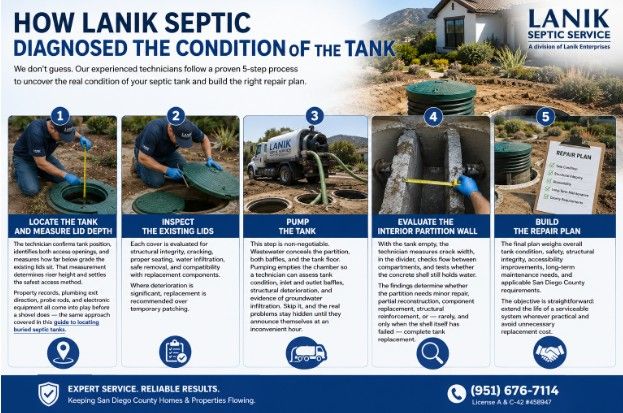
Lanik Septic Service does not quote structural work from a description over the phone. Experienced technicians verify actual condition rather than relying on what is visible from the surface.
The technician confirms tank position, identifies both access openings, and measures how far below grade the existing lids sit. That measurement determines riser height and settles the safest access method.
Property records, plumbing exit direction, probe rods, and electronic equipment all come into play before a shovel does — the same approach covered in this guide to locating buried septic tanks.
Each cover is evaluated for structural integrity, cracking, proper seating, water infiltration, safe removal, and compatibility with replacement components. Where deterioration is significant, replacement is recommended over temporary patching.
This step is non-negotiable. Wastewater conceals the partition, both baffles, and the tank floor. Pumping empties the chamber so a technician can assess tank condition, inlet and outlet baffles, structural deterioration, and evidence of groundwater infiltration. Skip it, and the real problems stay hidden until they announce themselves at an inconvenient hour.
With the tank empty, the technician measures crack width in the divider, checks flow between compartments, and tests whether the concrete shell still holds water.
The findings determine whether the partition needs minor repair, partial reconstruction, component replacement, structural reinforcement, or — rarely, and only when the shell itself has failed — complete tank replacement.
The final plan weighs overall tank condition, safety, structural integrity, accessibility improvements, long-term maintenance needs, and applicable San Diego County requirements. The objective is straightforward: extend the life of a serviceable system wherever practical and avoid unnecessary replacement cost.
A documented septic tank inspection and certification puts that finding in writing for lenders, buyers, or county review.
A cracked lid is rarely the whole story. Lanik Septic Service inspects the full tank before quoting — book a Fallbrook inspection and find out what you’re actually dealing with.
If you’re ready to get started, call us now!
With the inspection complete and the concrete shell confirmed sound, the recommended plan addressed all three issues during one visit — reducing labor duplication, minimizing disruption, and restoring the system to intended function.
When a lid shows structural deterioration, replacement beats repair. A patched cover rarely regains its original load rating or its watertight seal, and both matter.
The plan called for modern, properly fitted access covers rated for residential septic service, seated to seal against surface water intrusion.
Both tank access openings were extended to grade using durable riser assemblies — heavy-duty polyethylene or PVC, sized to match the tank openings, with watertight seals to limit surface water infiltration and secure covers at the top.
Height is always site-specific, which is exactly why the depth measurement in Step 1 comes before anything is ordered.
The payoff is permanent: no digging during pumping, faster service appointments, lower maintenance labor, easier inspections, improved emergency access, and no repeated damage to lawns or irrigation.
For homeowners planning to stay in the house, risers are among the highest-value upgrades available on an older system.
Repair options scale to the damage found: rebuilding damaged concrete sections, installing approved replacement partition components, reinforcing deteriorated areas, addressing inlet or outlet baffles where needed, and verifying proper wastewater flow between compartments before backfill.
Where the tank remains structurally sound, restoring the partition is dramatically more economical than full system replacement — and it keeps a functioning asset in the ground rather than in a landfill.
Fallbrook sits in unincorporated San Diego County, where onsite wastewater treatment systems fall under county jurisdiction.
California Water Code section 13282 authorizes Regional Water Quality Control Boards to delegate OWTS permitting to local agencies, and the State Water Resources Control Board’s OWTS Policy, effective May 13, 2013, established the statewide framework counties operate within.
San Diego County administers that authority through its Local Agency Management Program, approved by the San Diego Regional Water Quality Control Board on April 27, 2015, with updated program forms effective February 1, 2025. Under that program, work modifying or replacing a major component of an OWTS requires a septic repair permit from the Department of Environmental Health and Quality, and county staff inspects the completed work.
Scope determines the requirement — routine pumping sits in a different category from structural modification. The county’s septic program FAQ is the authoritative reference, and broader state rules are summarized in this overview of Southern California septic regulations.
Requirements change; homeowners should confirm current scope with their contractor before excavation begins.
California also regulates who may perform this work. The Contractors State License Board’s C-42 Sanitation System Contractor classification covers fabrication and installation of septic tanks and sewage disposal structures. Lanik Septic Service holds California license A and C-42 #458947.
| Work completed | What changes for the homeowner |
| New load-rated access lids | Collapse hazard removed; stormwater infiltration sealed at the opening |
| Risers extended to finished grade | No excavation at any future pumping, inspection, or certification |
| Interior partition restored | Solids retained in the first compartment, away from the absorption field |
| Full-tank inspection documented | Written condition record available for escrow, lenders, or county review |
| One-year labor warranty | Coverage on most Lanik installations and repairs |
The immediate results are safety and access. The compounding result is maintenance behavior, and that matters more than anything else on this list.
Accessible tanks get maintained. Buried tanks get ignored until something fails.
The United States Environmental Protection Agency recommends servicing a typical system every 1 to 3 years, and its guidance on caring for a septic system assumes a technician can measure scum and sludge layers and record the tank condition at each visit — none of which happens reliably when the openings remain buried under 2 feet of soil.
Given that roughly one in five American homes relies on a septic system, the gap between systems that get inspected and those that get ignored is where most premature failures occur.
Homeowners unsure of their own interval can check recommended pumping frequency for California systems against household size and tank capacity, and anyone preparing for a sale should understand the difference between certification and inspection before scheduling.
Septic systems are among the most important and least visible parts of a home. When something goes wrong, homeowners need more than a fast patch.
They need a contractor who identifies the underlying problem, explains the options in plain language, and recommends the repair that makes sense over the next twenty years rather than the next twenty minutes.
Lanik Septic Service is a fourth-generation, locally owned company operating out of Temecula and serving southwest Riverside County and North San Diego County.
Whether the job involves replacing a damaged lid, setting risers, restoring an interior baffle wall, or handling broader septic tank repairs, the objective remains the same: repairs that improve safety, extend system life, and help homeowners avoid replacement costs they don’t need to pay yet.
How much does septic tank lid replacement cost in Fallbrook?
Pricing depends on tank size, lid material, burial depth, and whether crews complete other repairs during the same visit. Lanik Septic Service quotes after inspecting the tank, because a cracked lid frequently signals wider structural deterioration that changes the scope entirely.
How much does septic riser installation cost?
Riser pricing tracks the depth of the existing tank, the number of access openings, and the riser system specified. Installing risers alongside a scheduled pumping or repair costs meaningfully less than booking a separate visit that repeats the same excavation.
Is installing septic risers worth the investment?
Risers pay back on any tank with buried lids. Extending both openings to grade removes excavation labor from every future pumping, inspection, and certification, which shortens appointments, lowers repeat costs, and protects lawns and irrigation from repeated digging on the property.
Can a damaged septic compartment wall be repaired?
A cracked divider is often repairable when the surrounding concrete shell stays sound. Technicians rebuild damaged sections, replace baffle components, and verify flow between compartments. Full tank replacement is recommended only when cracking, leakage, or deterioration extends across the structure itself.
When should a septic tank be replaced instead of repaired?
Replacement makes sense when the shell shows extensive cracking, severe deterioration, significant leakage, or several failed components at once. Isolated failures such as damaged lids, baffles, or partitions are usually repairable without disturbing the drain field or the tank body.
How deep are septic tank lids usually buried in Fallbrook?
Burial depth on older Fallbrook properties ranges from a few inches to several feet, depending on original grading and later landscaping. Risers close that gap permanently by extending each opening upward until the lid sits flush with finished grade.
What are the signs of a failing septic baffle or partition?
Repeat backups, slow household drains, odors near the tank, and soggy ground above the drain field all point toward failed internal components. Because the partition sits inside the tank, most failures surface only during a scheduled pumping or certification inspection.
Will replacing the lids improve septic system performance?
New lids improve safety, access, and protection against water intrusion rather than treating wastewater directly. Sealing out stormwater protects settling performance inside the tank, and accessible covers make routine maintenance that preserves the system far easier to complete.
How often should a Fallbrook septic system be inspected?
The United States Environmental Protection Agency recommends servicing a typical septic system every one to three years. Tank size, household size, water use, and garbage disposal habits shift that interval, so heavy-use properties often need attention more frequently than average.
Why choose a local septic contractor for this work?
Local contractors understand regional soil conditions, county permitting practices, and the system designs common to specific neighborhoods. Familiarity with Fallbrook and North San Diego County properties produces recommendations calibrated to local conditions rather than generic national guidance.
Cracked, buried, or simply unknown — the honest answer starts with opening the tank and looking. Call (951) 676-7114 or request a Fallbrook septic inspection, and we’ll tell you what we find.
Reviews
“This company is BEYOND helpful. Great customer service in the office, hard working employees in the field, reliable and very trust worthy. Having to replace an entire septic system is not something we ever intended on doing, but had to. If it hadn't been for Lanik Enterprises, Inc, I don't know where we would be. I HIGHLY RECOMMEND Lanik Enterprises!”
- Chanel Leos
