

License A & C-42 #458947

Originally published: January 2026 | Updated: March 2026

Data last verified: March 2026
A septic distribution box (D-box) is a concrete or plastic junction that evenly distributes wastewater from your septic tank to all drainfield lateral lines.
When it fails, symptoms include uneven wet spots in the yard, slow indoor drains, and sewage odors. Fixes range from jetting clogged outlets ($200–$500) to full box replacement ($600–$2,000).
Your septic system’s distribution box sits between your septic tank and drain field, evenly splitting wastewater across multiple outlet pipes. When this small concrete or plastic box stops working right, the consequences appear fast: wet spots in the yard, foul odors, or slow drains throughout the house.
The septic repair cost in California depends heavily on whether the D-box needs cleaning, re-leveling, or full replacement — catching the problem early keeps the fix inexpensive.
A failing distribution box usually presents as uneven drainage in your yard. Some areas of your drain field get too much water while others stay dry.
Fixing it can be as simple as leveling the box, or you might need a full replacement if the damage is significant. Common problems with septic tank distribution boxes include clogs, tilting, cracks, and overflow, which can block proper wastewater flow.
Lanik Septic Service, C-42 Contractor #458947, can inspect your distribution box and drainfield flow before one trench fails. Call (951) 676-7114 or schedule an appointment online today.
If you’re ready to get started, call us now!
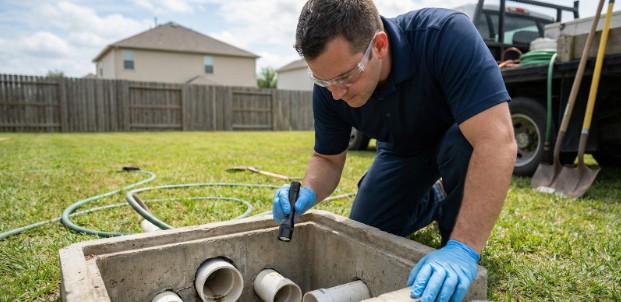
A distribution box is a concrete or plastic junction that receives effluent from the septic tank and distributes it equally to all drainfield lateral lines before it reaches the soil.
When any outlet clogs, the box tilts, or the structure cracks, wastewater no longer distributes evenly — and one drainfield section absorbs far more load than it is designed to handle.
The distribution box takes wastewater from your septic tank and splits it across several drain field lines. Many people mix up d-boxes with drop boxes or dosing tanks, but these parts serve different roles in your septic system.
A septic distribution box (d-box) sits between the septic tank and the drain field. It divides effluent equally among all leach lines, ensuring wastewater spreads evenly across your absorption field so no section gets overloaded.
A drop box is another name for a d-box — the term simply describes the same component that regulates effluent flow into the soil absorption field.
A dosing tank works differently. It stores wastewater and uses a pump to deliver measured doses to the leach field on a schedule. Your system needs a dosing tank only when gravity cannot move effluent to the drain fields on its own.
The d-box has several outlet pipes at the same height, so the liquid exits evenly from each. If an outlet clogs or the box shifts, the whole drainfield experiences uneven flow — and failure follows in the most overloaded trench.
The first signs of distribution box failure are slow indoor drains, gurgling plumbing, wet or soggy patches concentrated over one section of the drainfield, and sewage odors near or inside the house. These symptoms indicate unequal effluent flow — one drainfield trench is overloaded while others remain dry.
You will probably spot distribution box problems through a few warning signs around your property. These issues start subtly and worsen over time.
Slow drainage is often the first indicator. Sinks, showers, and toilets drain slowly, and you hear gurgling sounds when water runs. If you also notice septic odors inside the house, the distribution box is the first component to inspect after the septic tank.
Standing water or pooling water in the yard is another red flag. This usually appears near the drain field, the grass looks extra green, or the ground feels soggy underfoot.
Foul odors — rotten eggs or raw sewage — confirm that wastewater is not moving correctly through the distribution box.
Sewage backups are the worst-case scenario. When wastewater backs up into the house, you need fast professional attention.
Knowing the signs your septic tank is full helps you distinguish a full tank from a D-box failure before calling a contractor.
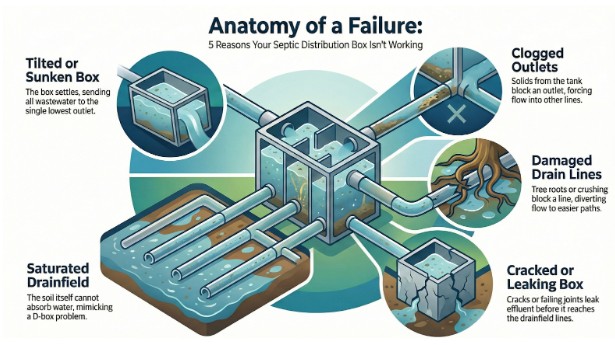
Distribution box problems occur when wastewater no longer splits evenly between the drainfield lines. The five causes are: a settled or tilted box, outlet clogs from solids carryover, root intrusion or crushed laterals, cracked or deteriorated box structure, and a saturated drainfield that mimics D-box symptoms.
If the D-box settles, the effluent runs to the lowest outlet, overloading one trench while the others remain underused. This creates persistent wet spots in one area and accelerates drainfield failure in that section.
Extra solids reaching the D-box partially block one outlet, forcing most flow into the remaining lines and causing uneven saturation. Routine septic pumping every 3–5 years removes the solids buildup that causes this problem before it reaches the distribution box.
If one drainfield line is blocked or crushed, flow diverts to the path of least resistance. One section absorbs far more than it should, while others stay dry — the D-box appears to function, but downstream damage drives the failure.
Cracks or failing joints leak effluent or disrupt flow paths, leading to localized wetness and poor lateral distribution. A cracked box cannot be re-leveled or jetted back to proper function — it requires replacement.
When the drainfield soil cannot absorb properly, symptoms mimic a D-box problem. The box looks fine, but the field is the real constraint.
A septic inspection in Southern California identifies whether the distribution box or the drainfield itself is the source of the problem.
Identify the failure type by the symptom pattern. Tilted boxes produce one saturated trench and dry adjacent ones. Clogged boxes back up water into the tank, leaving all drain lines dry. Broken boxes show visible cracks or soil collapse. Each pattern points to a different fix.
If your distribution box tilts, effluent flows unevenly into the drain field lines. One part of your yard stays wet or soggy, while other areas are bone dry. The box sits at an angle, so some pipes receive far more wastewater than others.
A clogged septic tank distribution box backs water up into the tank because effluent cannot exit. You see scum or solid waste blocking the pipes inside the box. Multiple drain field lines stay dry, and household drains move slowly throughout the property.
A fractured box is apparent on inspection. You see cracks in the concrete or plastic, or soil collapsing around the box. Baffles or outlet pipes may be broken off completely, causing effluent to leak directly into the surrounding soil rather than be distributed through the lateral lines.
Distribution Box Problem Patterns by Symptom
| Problem Type | Key Sign | Water Flow Pattern |
| Tilted | Uneven yard wetness | One line overloaded |
| Clogged | Back up into the tank | No flow to any lines |
| Broken | Visible damage | Leaking into soil |
Check the box location and pattern of yard wetness before calling a contractor. That diagnostic step gives the technician enough information to bring the right equipment and reduces time spent on-site.
The right fix depends on the failure type and the box’s structural condition. Outlet clogs respond to water jetting. A tilted box gets re-leveled with shims. A cracked or structurally failed box requires full replacement.
Most septic professionals recommend replacing any box over 30 years old that has multiple recurring issues.
If your D-box is clogged, water jetting clears the pipes without excavation. A plumbing snake handles smaller blockages. If the box sits unevenly, shims or speed levelers fix the tilt. Busted outlet baffles get repaired or replaced individually.
However, if the box has cracks, missing baffles, or a major structural failure, it requires replacement — not repair. Check septic tank repair in Riverside County for pricing and availability before making a decision.
Most septic professionals recommend replacement when the box is over 30 years old and has required multiple repairs — at that point, continuing to repair costs more than installing a new box.
Uneven wet spots or odors often signal D-box imbalance. Lanik Septic Service technicians diagnose and resolve both cleaning and replacement needs. Call (951) 676-7114 or contact us online.
If you’re ready to get started, call us now!
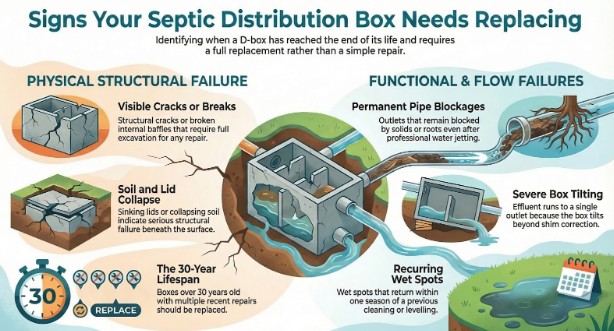
Clean a distribution box when outlets are clogged, but the structure is intact, and the box sits level. Replace it when the box is cracked, tilted beyond repair, or over 30 years old and experiencing recurring failures.
Cleaning costs $200–$500. Full replacement in California runs $600–$2,000. Lanik Septic Service, C-42 Contractor #458947, diagnoses and resolves both.
Septic distribution box repair, cleaning, and replacement options differ by condition, cost, and urgency — the table below identifies the correct action for each failure type.
Septic Distribution Box — Repair vs. Replace vs. Clean Decision Guide
| Action | Avg. Cost | When to Choose | Lanik Recommendation |
| Clean / Jet Outlets | $200–$500 | Outlets clogged by solids carryover; box is level, intact, and under 20 years old | First-line fix for most clog complaints; restores equal flow without excavation |
| Re-level / Shim Box | $300–$700 | Box has settled or tilted; no structural cracks; one trench receiving most effluent | Correct when the wet-spot pattern shows one saturated trench, and others stay dry |
| Full Replacement | $600–$2,000 | Box is cracked, baffles broken, or over 30 years old, with recurring failures | Required when structural damage prevents consistent equal distribution to all lateral lines |
D-boxes typically last 20–30 years before structural deterioration makes replacement more cost-effective than ongoing repairs.
A distribution box is a concrete or plastic junction that receives effluent from the septic tank and distributes it equally to all drainfield lateral lines before it reaches the soil.
California requires a permit for most septic component replacements, including distribution boxes. Riverside County OWTS regulations mandate inspection and approval before installation begins.
Distribution box cleaning restores even flow when the box holds its shape and outlets respond to jetting. Replacement becomes necessary when structural damage prevents the box from distributing wastewater equally across the drainfield lines.
The decision depends on the box’s physical condition, repair history, and the cost of septic repair in California relative to a full swap.
Lanik Septic Service, C-42 Contractor #458947, provides written diagnoses with transparent pricing so homeowners know which option applies before any work begins.
The EPA recommends inspecting your distribution box every 3–5 years during routine septic maintenance to catch outlet restrictions before they cause drainfield overload. Catching a clog early keeps the repair simple and inexpensive.
Homeowners who stay current on routine septic pumping reduce the solids carryover that clogs D-box outlets. The EPA notes most septic tank failures stem from deferred pumping — solids that accumulate past the tank’s capacity push into the distribution box and block outlet pipes.
A consistent 3–5 year pumping schedule eliminates this as a cause of D-box failure in most residential systems.
Keeping the effluent filter clean also prevents solids from carrying over into the distribution box. The effluent filter sits at the tank outlet and catches solids before they reach the D-box and lateral lines. A clogged filter forces solids past it — directly into the distribution box outlets.
When you identify distribution box problems, reduce water use immediately. Stop running laundry, dishwashers, and back-to-back showers. Avoid harsh chemicals and flush only human waste and toilet paper.
These steps reduce the volume of wastewater entering the damaged box and lower the risk of backup until a technician arrives.
When you spot distribution box problems, act fast to prevent sewage from backing up into the house. Review what not to flush in Southern California and follow that list strictly while your system is under stress.
Stop using harsh chemicals like drain cleaners, bleach, or antibacterial soaps. These products eliminate the beneficial bacteria in your septic tank that break down waste — without those bacteria, solids accumulate faster and reach the D-box sooner.
Do not run multiple water-using appliances simultaneously. Running laundry, the dishwasher, and showers back-to-back sends a surge of wastewater through a system that is already struggling to distribute flow evenly.
Never flush the following items:
Run only full loads in the washing machine and dishwasher. Take shorter showers and skip non-essential water use until the system is serviced.
If symptoms worsen — sewage odor increases, or drains stop entirely — call for emergency septic service rather than waiting for a scheduled appointment.
A thorough distribution box inspection covers the box’s physical structure (cracks, corrosion, lid integrity), water distribution (equal flow to all outlets, water levels, blockages), and all seals and connections (pipe joints, baffles, and filters).
Inspectors also check the surrounding soil for standing water or saturation, indicating a drainage problem.
Qualified inspectors check the box’s physical condition, water flow patterns, and all connections to confirm your system functions correctly.
Understanding the difference between a septic certification vs inspection helps you request the right service — a certification documents system condition for a real estate transaction, while an inspection diagnoses a specific problem.
Physical Structure
Water Distribution
Seals and Connections
Inspectors also check the soil around the box for standing water or soggy patches. They measure sludge levels and verify equal flow through all outlet pipes so no single drainfield section receives an outsized share of effluent.
If backups keep recurring, schedule a full tank-to-drainfield inspection in Riverside or North San Diego County. Call Lanik Septic Service at (951) 676-7114 or book online.
If you’re ready to get started, call us now!
Replacing a septic distribution box in California costs $600–$2,000 in total. The box unit runs $50–$400. Labor ranges from $500 to $1,300, depending on access difficulty and soil conditions.
Permits add $50–$300. California requires permits for most septic work under OWTS regulations.
Replacing a septic distribution box in California usually costs between $600 and $2,000. The price depends on several key factors.
Staying current with professional septic maintenance in California reduces the likelihood of needing emergency replacement and provides documentation of the system’s condition over time, which California counties increasingly require before issuing permits for repair work.
The distribution box itself runs $50–$400, depending on material and size. Labor ranges from $500 to $1,300 based on location and job complexity. Permits add $50–$300. California requires permits for most septic component replacements.
Lanik Septic Distribution Box Cost Factors — California
| Cost Item | Typical Range | Notes |
| Distribution box unit | $50–$400 | Concrete or plastic; size depends on the number of lateral lines |
| Labor | $500–$1,300 | Access difficulty and soil conditions drive variation |
| Permits | $50–$300 | Required for most septic work under California OWTS rules |
| Simple filter swap only | $200–$900 | Least expensive repair when box structure is intact |
| Full replacement (total) | $600–$2,000 | All-in estimate; higher end if laterals need rerouting |
Get quotes from at least two licensed C-42 contractors before committing. Compare prices and confirm that the scope of work includes the permit, inspection, and backfill — not just the box itself.
A septic distribution box (D-box) splits wastewater leaving the tank into multiple drainfield lines, maintaining balanced flow. When distributed evenly, the drainfield absorbs effluent more uniformly and lasts longer.
Common signs include uneven soggy areas over part of the drainfield, slow drains or gurgling plumbing, odors near the field, and intermittent backups after heavy water use. These patterns indicate unequal flow to drain lines.
Distribution boxes settle as soil shifts, erosion occurs, or installation compaction is inadequate. Even slight out-of-level conditions send most effluent to a single outlet, overloading one trench while others remain underused.
Yes. If a D-box outlet clogs or flow becomes unbalanced, effluent ponds in one drainfield section and surfaces as wet spots or odors. EPA notes malfunctions present as standing water and unequal drainage.
Most homeowners should avoid DIY D-box work because it requires excavation, proper line identification, and safe handling of wastewater. EPA notes evaluations involve excavating parts of the drainfield and checking the box for equal flow to all lines.
A settled box gets re-leveled. Restricted outlets get cleared by jetting. Cracked or deteriorated boxes get replaced. EPA specifically recommends checking D-box structural integrity and confirming equal flow to all lines before closing the inspection.
Minor repairs run from a few hundred to about $1,500. Full replacement costs $600–$2,000, depending on access difficulty and whether laterals need rerouting. Most California counties require permits for replacement work.
Reviews
“This company is BEYOND helpful. Great customer service in the office, hard working employees in the field, reliable and very trust worthy. Having to replace an entire septic system is not something we ever intended on doing, but had to. If it hadn't been for Lanik Enterprises, Inc, I don't know where we would be. I HIGHLY RECOMMEND Lanik Enterprises!”
- Chanel Leos
