

License A & C-42 #458947

Originally published: May 2026
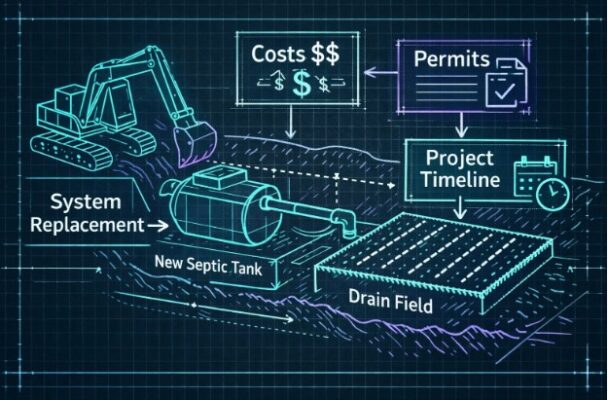
Septic system replacement in California costs $10,000 to $20,000 for a conventional system as of April 2026, and it is necessary when the drain field fails, not when drains run slowly or backups occur.
Lanik Septic Service installs and obtains permits for replacement systems throughout Riverside and San Diego counties, including conventional, mound, and ATU configurations.
A failing septic tank replacement project moves faster and costs less when you understand the physical signs that trigger it, what Riverside County’s permitting process actually requires, and what separates a complete contractor bid from a vague one. Knowing what to expect before the first contractor call puts you in a measurably stronger position.
The distinction between a repair and a full replacement comes down to whether the drain field is still functional. Most septic problems that look alarming — a slow drain, a gurgling toilet — are early-stage symptoms that septic tank pumping or a targeted pipe repair can resolve.
A full septic system replacement becomes necessary only when the drain field itself has failed, not before.
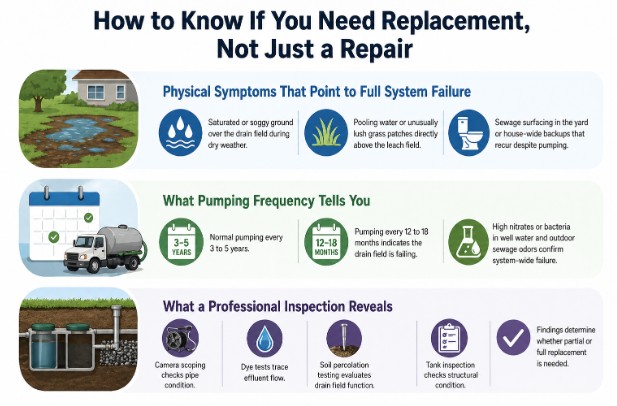
Saturated or soggy ground over the drain field during dry weather is the clearest physical sign that the soil can no longer absorb effluent.
Pooling water or unusually lush grass patches directly above the leach field indicate wastewater returning to the surface because it has nowhere else to go.
Sewage surfacing in the yard or house-wide backups that recur despite pumping confirm end-of-life failure rather than a clog.
Early-stage issues like a single slow drain or occasional gurgling are worth investigating, but do not automatically mean full replacement.
The red flag is pattern and scope: multiple fixtures backing up simultaneously, problems returning quickly after pumping, or persistent outdoor sewage odors regardless of weather, all point to systemic failure rather than an isolated component problem.
A well-functioning septic system needs pumping every three to five years under normal household use. A tank that requires pumping every 12 to 18 months is a strong indicator that the drain field is no longer processing effluent — the tank fills quickly because liquid is not moving through the system correctly.
High nitrate or bacterial levels in nearby well water and persistent outdoor sewage odors provide further confirmation that failure has moved beyond the tank and into the soil-dispersal system.
A licensed contractor uses camera scoping to assess pipe condition, dye tests to trace effluent flow, and soil percolation testing to evaluate whether the existing drain field can still function.
Inspectors also assess the tank’s structural condition — cracks, collapsed baffles, and compromised lids all affect the scope and cost of replacement. Inspection findings determine whether leach field replacement alone is sufficient, or whether the full system — tank and drain field — requires replacement.
Before scheduling a contractor visit for a baseline understanding of how septic inspections work in Southern California, reviewing the process in advance helps homeowners ask sharper questions.
If you’re ready to get started, call us now!
The type of replacement system a Southern California property requires depends on soil conditions, lot size, groundwater depth, and county regulations.
Not every property can support every system type, and a mismatched system design will fail again. The EPA’s septic system guide provides a concise overview of common configurations and how each functions under different site conditions.
Conventional gravity systems pair a septic tank with a gravel drain field and represent the lowest-cost option when soil conditions allow adequate percolation. Chamber systems replace gravel with open-bottom plastic chambers, handling higher groundwater and variable flow more effectively.
The installation cost is comparable to that of conventional gravity systems, though slightly higher. Both types require adequate soil percolation — properties with soil that cannot process effluent at an acceptable rate require a different approach entirely.
Mound systems address sites with shallow bedrock, high water tables, or impermeable soils common across Riverside County. A raised sand mound handles treatment above the natural ground level, bypassing the problematic soil layer.
The cost trade-off is significant: mound systems require pumps, engineered fill, substantial sand volume, and detailed site engineering, all of which push the price well above that of a conventional replacement.
Aerobic treatment units (ATUs) use oxygen pumps to accelerate wastewater breakdown and produce higher-quality effluent before dispersal. Riverside and San Diego county regulations determine which system type is permitted on a given parcel — a licensed contractor familiar with your county’s current LAMP requirements can confirm what your site will require before any design costs are committed.
California homeowners pay above national averages for septic work. Based on regional contractors’ experience, a full conventional system replacement in California for a standard three-bedroom property runs $10,000 to $20,000 as of April 2026 — and that figure does not account for the site complications common across Southern California.
For a breakdown of what drives the total replacement cost in Riverside and San Diego counties, reviewing regional cost data before requesting quotes will sharpen your budget.
Tank-only replacement, when the drain field remains functional, runs $3,000 to $7,000 installed as of April 2026. Drain field replacement typically costs $5,000 to $15,000 for straightforward sites; complex conditions, including poor soil, high water tables, or engineered fill requirements, can push that figure to $16,000 or more.
A full system replacement covering both the tank and drain field for a conventional design costs $10,000 to $20,000 in California.
Alternative systems, including mound and ATU installations, start around $10,000 and can reach $25,000 or higher depending on site engineering requirements.
Permit fees in Riverside and San Diego counties add real cost before excavation begins. Budget for soil testing, design review, and inspection fees as separate line items — each is a required component of the permitting process before installation begins.
Southern California soils, particularly the expansive clay soils found across Riverside County, frequently require engineered drain field designs with select fill, larger field areas, and additional soil borings, all of which increase project costs beyond those of a comparable system in areas with favorable soil conditions.
System size is determined by bedroom count and daily water usage — a four-bedroom home requires a larger tank and drain field than a two-bedroom property, which directly affects the total replacement cost.
Getting three bids from licensed C-42 contractors is the most reliable way to validate whether a quote reflects fair market pricing for your specific site.
What septic repair costs look like when a failing component triggers a larger replacement scope, review component-level pricing before your contractor meeting to clarify what you are actually paying for.
If you’re ready to get started, call us now!
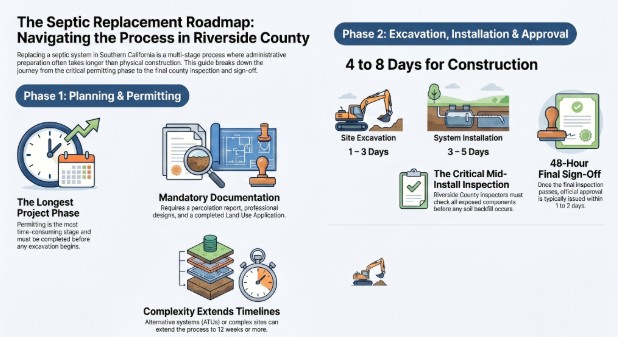
Most Southern California homeowners underestimate how much of the total timeline is consumed before excavation begins. In California, the permitting phase is the longest single phase of the entire project, and a contractor’s permit experience directly affects how long that phase takes.
Riverside County requires a formal OWTS construction permit before any replacement work begins. Per the Riverside County Department of Environmental Health, a new system installation requires a percolation report, detailed plans signed by a Professional of Record registered with the department, and a completed Land Use Application submitted with supporting documentation and fees.
Alternative systems, such as ATUs, require additional documentation and an annual operating permit after installation.
Riverside County permit review timelines vary by project complexity and application completeness — contractors with in-house permit processors who submit accurate applications the first time move through this phase faster than those who resubmit.
Once permits are approved, excavation at a standard Southern California residential site typically takes 1 to 3 days. Full installation — tank placement, drain field construction, and connections — runs three to five days for most residential systems.
Experienced operators who have completed installations across a documented range of soil conditions, setback configurations, and county-specific permit requirements across Riverside and San Diego counties work faster and encounter fewer on-site surprises, which matters significantly on lots with slope, proximity to wells, or irregular soil.
Riverside County inspectors check exposed components at a mid-installation stage before any backfill occurs.
Final inspection confirms that the completed system matches the permitted design exactly, and final approval is typically issued within 1 to 2 days after the inspection passes.
For a standard residential replacement with no complications, the total timeline from permit submission to final approval varies based on application completeness and site complexity.
Complex sites, alternative system requirements, or incomplete permit submissions can extend the process to 12 weeks or more — a timeline worth knowing before setting expectations with your household or a real estate transaction.
Financial assistance for septic replacement is available through federal programs, but most target rural, low- to moderate-income homeowners, and funding availability varies annually.
Knowing which programs exist and who qualifies helps Southern California homeowners pursue the right options before funding cycles close.
USDA Rural Development Water and Waste Disposal Loan and Grant Program: Funds septic installations in eligible rural areas and accepts applications on a rolling annual cycle. Southern California homeowners in rural areas of Riverside and San Diego counties may qualify, depending on location and income.
EPA Clean Water State Revolving Fund (CWSRF): Channels low-interest loans through the California State Water Resources Control Board. Communities with populations under 20,000 and below 80 percent of the statewide median household income may qualify for grants or principal forgiveness rather than standard loans.
USDA Section 504 Home Repair Program: Offers loans of up to $40,000 as of April 2026, with a fixed 1% interest rate over 20 years, for very-low-income rural homeowners facing health and safety hazards, including failing septic systems.
Homeowners age 62 or older may combine a loan with a grant of up to $10,000, for a combined total of up to $50,000 in assistance. The USDA Rural Development program page provides current eligibility requirements and the intake form for starting the application process.
Loans are more broadly accessible than grants across all programs. Grant eligibility is generally limited to income-qualified homeowners, and most programs require documented proof of system failure through inspection reports, rural property location, and owner-occupancy.
Funding cycles shift annually, and some programs are exhausted until the next allocation period.
The local USDA Rural Development field office and your county health department are the most direct contacts for current availability in Riverside and San Diego counties.
In California, septic system installation requires a C-42 contractor license. A C-42 license is the baseline requirement. What sets contractors apart beyond it is local experience, permit-handling capability, and accountability after the job is complete.
Ask for the contractor’s C-42 license number and verify it is current through the California Contractors State License Board. Ask how many systems the contractor installs annually and whether permit processing is handled in-house or outsourced.
A high-volume local installer with extensive experience in your county will have encountered a documented range of soil conditions, setback configurations, and county-specific permit requirements — and that experience directly reduces installation risk. Ask for references from jobs completed specifically in your county, since permitting knowledge does not transfer between jurisdictions, and familiarity with local inspectors matters when mid-project permit corrections or failed inspections add weeks to the timeline.
A complete bid itemizes tank size and material, drain field design type and square footage, permit fees, labor, and any engineering costs. A vague lump-sum bid with no line items is a red flag — without a breakdown, there is no basis for comparison and no way to evaluate what you are actually buying.
The lowest number is not automatically the best choice. Evaluate what is included, the contractor’s track record in your county, and whether the contractor stands behind completed work with a documented labor warranty.
The decision between repair and replacement hinges on specific physical signs and professional inspection findings.
In Southern California, site conditions, system type requirements, and Riverside County permitting rules make local expertise the most critical factor in getting that call right the first time.
Understanding realistic septic installation costs, the permitting sequence, and the right questions to ask before signing a contract protects you from mid-project cost overruns and failed inspections that contractors without local permit experience routinely produce.
Contact Lanik Septic Service to schedule a septic replacement assessment for your Riverside County or San Diego County property.
How do I know if my septic system needs full replacement or just a repair?
A full replacement is necessary when the drain field has failed, not when slow drains or gurgling occur. A licensed inspector uses camera scoping, dye tests, and soil percolation testing to confirm whether the drain field is still functional or requires full replacement. Symptoms alone cannot make that determination accurately.
What does a full septic system replacement cost in California in 2026?
A full conventional system replacement in California costs $10,000 to $20,000 as of April 2026. Mound and ATU systems start at $10,000 and can reach $25,000 or more, depending on site engineering requirements, soil conditions, and Riverside County permit fees.
How long does septic system replacement take in Riverside County?
Septic system replacement timelines in Riverside County vary based on application completeness and site complexity. The permitting phase, not installation, typically consumes the most time — complex sites or alternative system types can extend the full process to 12 weeks or more.
What permits are required for septic replacement in Riverside County?
Riverside County requires a formal OWTS construction permit before any replacement work begins. A new installation also requires a percolation report and detailed plans signed by a Professional of Record registered with the department. ATU installations require an additional annual operating permit. All applications are submitted to the Riverside County Department of Environmental Health.
Does financial assistance exist for septic system replacement in Southern California?
Financial assistance for septic replacement in Southern California includes USDA Section 504 loans of up to $40,000 at a 1% fixed interest rate, with an additional $10,000 grant available for homeowners aged 62 or older. The EPA Clean Water State Revolving Fund provides low-interest financing through the California State Water Resources Control Board for qualifying communities.
What should I look for when comparing contractor bids?
A complete bid itemizes tank size and material, drain field type and square footage, permit fees, labor, and engineering costs separately. A lump-sum bid without line items provides no basis for comparison. Verify the contractor’s C-42 license through the California Contractors State License Board and ask for references from completed projects in your county.
How does system type affect replacement cost in Southern California?
Conventional gravity systems cost the least when soil percolation is adequate. Mound systems — required on sites with high water tables, shallow bedrock, or clay-heavy soils in Riverside County — cost more due to engineered fill, pumps, and site engineering. ATU systems carry higher upfront costs and mandatory annual servicing under Riverside County’s LAMP.
How can I reduce septic system replacement costs in California?
Getting three bids from licensed contractors before committing is the most direct way to validate pricing. Choosing a contractor that handles permits in-house avoids the resubmission costs that outsourcing permit work introduces. Addressing septic failure signs early gives you more time to compare bids and explore financing options before emergency-rate pricing applies.
Reviews
“This company is BEYOND helpful. Great customer service in the office, hard working employees in the field, reliable and very trust worthy. Having to replace an entire septic system is not something we ever intended on doing, but had to. If it hadn't been for Lanik Enterprises, Inc, I don't know where we would be. I HIGHLY RECOMMEND Lanik Enterprises!”
- Chanel Leos
