

License A & C-42 #458947

Originally published: May 2026

A failing leach field produces 10 recognizable warning signs — from soggy ground and lush grass patches above drain lines to house-wide slow drains and sewage odors — that appear well before full system breakdown.
Catching leach field failure signs early in Southern California is the difference between a targeted septic repair costing $1,000 to $7,500 and a full replacement running $10,000 to $20,000 or more.
Lanik Septic Service has diagnosed and repaired septic systems across southwest Riverside County and north San Diego County for over 30 years.
A failing leach field produces visible yard symptoms before any indoor plumbing problem appears. Soil above a failing drain field behaves differently from healthy soil — saturating, discoloring surrounding vegetation, and eventually surfacing effluent — and recognizing those changes early keeps repair options open.
Southern California homeowners with properties in Riverside County’s foothill and rural communities are especially likely to experience these symptoms due to the clay-rich soils common throughout the region.
Mushy or saturated soil directly above leach lines during dry Southern California weather is a sign of drain field failure, not a drainage quirk. Biomat — the organic layer that forms naturally in leach lines — clogs soil pores when it accumulates beyond the field’s capacity to manage, forcing effluent back toward the surface instead of percolating downward.
Spongy ground or standing puddles above the field on a dry afternoon confirm the soil has lost its absorption capacity and requires professional evaluation.
A strip of grass noticeably greener and thicker than the surrounding lawn, positioned directly above leach lines, signals partially treated wastewater surfacing underground and fertilizing root systems from below.
Lush grass above the field appears in any season and is most visible during dry spells when the surrounding turf looks normal or stressed. Southern California summers make this sign especially easy to spot — a healthy field produces no visible difference in vegetation growth above it.
A functioning septic system keeps all odors contained underground. Sewage odors detected outside near the tank or drain field area mean the system is no longer filtering waste properly, and gases are escaping to the surface. Outdoor septic odors are distinct from indoor plumbing smells and confirm that effluent is reaching areas it should not.
Two or more yard symptoms appearing together — soggy ground, lush grass, and outdoor odors — represent a clear call for septic inspection rather than a reason to wait.
If you’re ready to get started, call us now!
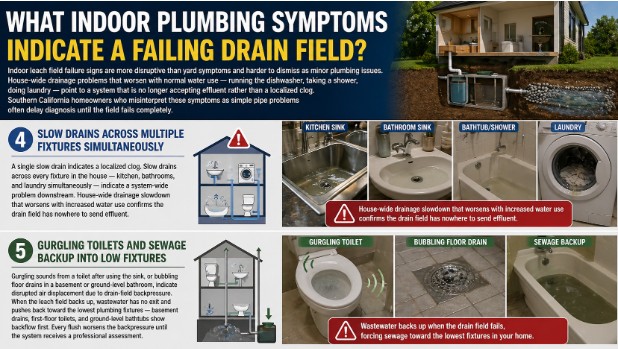
Indoor leach field failure signs are more disruptive than yard symptoms and harder to dismiss as minor plumbing issues. House-wide drainage problems that worsen with normal water use — running the dishwasher, taking a shower, doing laundry — point to a system that is no longer accepting effluent rather than a localized clog.
Southern California homeowners who misinterpret these symptoms as simple pipe problems often delay diagnosis until the field fails completely.
A single slow drain indicates a localized clog. Slow drains across every fixture in the house — kitchen, bathrooms, and laundry simultaneously — indicate a system-wide problem downstream. House-wide drainage slowdown that worsens with increased water use confirms the drain field has nowhere to send effluent.
The septic systems guide covers how conventional drain fields process effluent and why soil saturation produces this whole-house symptom pattern.
Gurgling sounds from a toilet after using the sink, or bubbling floor drains in a basement or ground-level bathroom, indicate disrupted air displacement due to drain-field backpressure.
When the leach field backs up, wastewater has no exit and pushes back toward the lowest plumbing fixtures — basement drains, first-floor toilets, and ground-level bathtubs show backflow first. Every flush worsens the backpressure until the system receives a professional assessment.
A slow drain does not automatically mean the leach field is failing — a clogged pipe produces similar symptoms and costs far less to fix. Distinguishing between the two before calling a contractor determines whether the correct diagnosis is a $300 snaking job or a $10,000 field replacement. Southern California homeowners can run two practical tests before scheduling a full inspection.
Testing all fixtures simultaneously reveals whether the problem is localized or system-wide. Running water in the kitchen, bathrooms, and laundry room at the same time confirms whether slow drainage or gurgling appears across multiple fixtures or only one.
A problem limited to one sink or toilet, with the rest of the house draining normally, points to a localized clog that responds to snaking.
Slow drainage or gurgling across all fixtures simultaneously confirms a system-wide problem — and a clogged pipe is the wrong diagnosis — so you can pursue the correct fix, snaking for a clog or professional inspection for a system-wide problem, without wasting money on the wrong repair.
Backups and slow drains returning within days of tank pumping confirm the leach field — not the tank — has failed. A fully saturated or clogged field provides only brief relief during pumping because the soil still cannot accept effluent, regardless of tank capacity.
Symptoms returning within days of pumping are among the clearest signs of drain field failure. DIY chemical treatments and drain additives do not fix leach field problems and damage the beneficial bacteria a septic system depends on to function — skip them entirely.
Leach field failure in Southern California follows three primary patterns: soil saturation from water overload, physical damage from root intrusion or compaction, and solids migration from an unmaintained tank.
Understanding which pattern caused the failure helps homeowners have a more productive conversation with a contractor and sets accurate expectations for repair scope and cost.
Every leach field has a finite absorption capacity determined by soil type, field size, and household water usage. Heavy laundry loads, leaking fixtures, misdirected roof runoff, or high occupancy push water into the field faster than the soil can recover — keeping soil pores saturated and eliminating the field’s ability to treat and disperse effluent.
Saturation-driven leach field damage in Southern California’s clay-heavy Riverside County soils rarely self-corrects.
A professional evaluation determines whether resting the field restores function or whether repair is required. For a broader look at how climate impacts septic systems in Southern California affects regional soil and weather patterns, saturation failure rates are a documented local concern.
Tree and shrub roots actively seek moisture in leach lines — and once roots find an entry point, they block flow and accelerate biomat buildup in affected sections.
Uneven drainage results, with some leach line sections backing up while others still function. Soil compaction from vehicle traffic or construction equipment driven across the field destroys the porous structure on which absorption depends.
Root intrusion and soil compaction both cause localized damage that can spread across the entire field if left unaddressed.
A septic tank that has not been pumped on schedule — every three to five years under normal household use — accumulates sludge and scum beyond its holding capacity.
Solids eventually escape through the outlet baffle and migrate into the leach lines, clogging the gravel bed and accelerating biomat formation across the field.
Solids migration is one of the most preventable causes of leach field failure in Southern California, and it progresses gradually until the field is fully saturated. Physical signs include house-wide backups, persistent foul odors, and pooling wastewater above the field. Following proven maintenance tips for Southern California septic systems significantly reduces the risk of solids migration.
A professional leach field inspection is a sequential diagnostic process from the tank to the field that identifies not just that the field is failing, but why, so the repair plan addresses the actual cause rather than the surface symptom.
Lanik Septic Service completes more than 1,000 septic inspections annually across southwest Riverside County and north San Diego County, following a full diagnostic sequence on every visit.
The inspection starts at the tank: checking liquid levels, inspecting inlet and outlet baffles for condition and flow, and identifying signs of backflow or reverse drainage. The inspector then assesses the distribution box for damage or uneven flow to the leach lines before moving to the field itself.
Surface signs, including saturation, odors, and vegetation patterns, are documented. Leach lines are probed for blockage, and camera inspection confirms specific problem areas where access allows. Inspection findings determine whether the property needs a targeted repair or a full replacement — and getting that answer early keeps more options available.
According to the EPA’s septic system guidance, routine professional inspection is the most reliable method for detecting field problems before they lead to irreversible failure.
If you’re ready to get started, call us now!
A failing leach field does not always require full replacement. The correct path depends on what failed, how severe the failure is, and how long the failure has been progressing.
Lanik, a C-42-licensed contractor serving southwest Riverside County and north San Diego County, handles both targeted repairs and full replacements, with in-house permit processing through Riverside County’s LAMP program.
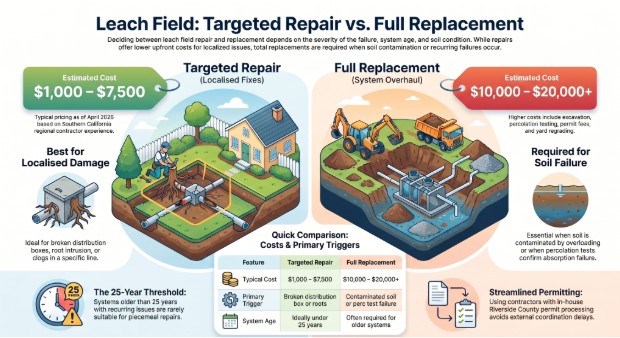
Targeted repairs address localized damage: a broken distribution box, root intrusion in one section of line, or a specific area of clogging that has not spread across the field.
Based on regional contractor experience, targeted leach field repairs in California range from $1,000 to $7,500 as of April 2026, depending on access, scope, and soil conditions.
Repairs cost less upfront but require an honest assessment of system age — a field older than 25 years with recurring problems is rarely a good candidate for piecemeal repair. Review system costs by repair type and system age before committing to a repair scope.
Full leach field replacement becomes necessary when the soil itself is contaminated from years of overloading, when the field fails repeatedly after targeted repair, or when percolation testing confirms the existing area can no longer support absorption.
Full replacement in California runs $10,000 to $20,000 or more as of April 2026, depending on soil conditions, system size, site access, and Riverside County permit requirements.
Percolation testing, permit fees, and yard regrading add to that total. Working with a contractor who handles Riverside County permitting in-house avoids the coordination delays that result from outsourcing the permit process to a third party.
Leach field failure signs do not resolve on their own. Soggy ground, lush grass strips above drain lines, house-wide slow drains, and outdoor sewage odors all warrant a professional inspection — not a wait-and-see approach and not a chemical treatment.
A homeowner who identifies two or three of these signs early and schedules an inspection with a licensed contractor faces a repair bill measured in thousands.
A homeowner who waits until sewage surfaces in the yard or backs up through the floor drain faces a replacement bill measured in tens of thousands.
Contact Lanik Septic Service to schedule a leach field inspection for your Riverside County or San Diego County property today.
What are the first signs of a leach field failure?
The first signs of leach field failure are soggy or spongy ground above drain lines during dry weather, a strip of unusually green grass directly over the leach field, and outdoor sewage odors near the tank or field area. These yard-level symptoms typically appear well before indoor plumbing problems develop.
What does a failing leach field smell like?
A failing leach field produces a sewage odor that is detectable outdoors near the tank or drain field. The smell is distinct from indoor plumbing odors and indicates that effluent is reaching the soil surface rather than percolating properly. Outdoor septic odors confirm the system is no longer filtering waste effectively.
Can a leach field be repaired, or does it always need replacement?
A leach field can be repaired when damage is localized — a broken distribution box, root intrusion in one line section, or a contained clog. Based on regional contractors’ experience, targeted repairs in California range from $1,000 to $7,500 as of April 2026. Full replacement becomes necessary when soil contamination extends across the entire field.
What causes leach fields to fail in Southern California?
Leach fields in Southern California fail for three primary causes: soil saturation from water overload, root intrusion, and soil compaction that destroys leach line integrity, and solids migration from a tank that is not pumped every three to five years. Clay-heavy soils in Riverside County accelerate saturation-driven failure.
How do I know if my slow drains are a pipe clog or a leach field failure?
Slow drains limited to one fixture indicate a localized pipe clog. Slow drains across every fixture simultaneously — kitchen, bathrooms, and laundry — indicate a system-wide drain field problem. Backups returning within days of tank pumping confirm leach field failure rather than a tank or pipe problem.
How often should a septic tank be pumped to protect the leach field?
A septic tank should be pumped every three to five years under normal household use to protect the leach field from the migration of solids. Tanks that go beyond five years without pumping accumulate sludge past holding capacity, allowing solids to escape into leach lines and accelerate biomat buildup across the field.
What does a leach field inspection cost in Southern California?
Leach field inspection costs in Southern California vary by contractor and scope. A full diagnostic inspection — covering tank condition, distribution box, and field assessment with surface and probe evaluation — provides the findings needed to determine whether repair or replacement is appropriate. Contact a licensed C-42 contractor in Riverside or San Diego County for current inspection pricing.
How long does a leach field last in California?
A leach field in California lasts 20 to 30 years with proper maintenance, including regular tank pumping every three to five years, controlled water use, and keeping vehicle traffic and deep-rooted vegetation away from the field. The California OWTS Policy identifies ongoing maintenance as the primary factor in system longevity.
What should I do if sewage is surfacing in my yard?
Sewage surfacing in the yard confirms active leach field failure and requires immediate professional assessment — not chemical treatments or additional water use. Reducing household water use until the inspection limits further field damage. A licensed C-42 contractor confirms whether targeted repair or full replacement is required under Riverside County’s OWTS permit process.
Reviews
“This company is BEYOND helpful. Great customer service in the office, hard working employees in the field, reliable and very trust worthy. Having to replace an entire septic system is not something we ever intended on doing, but had to. If it hadn't been for Lanik Enterprises, Inc, I don't know where we would be. I HIGHLY RECOMMEND Lanik Enterprises!”
- Chanel Leos
