
License A & C-42 #458947

Originally published: March 2026
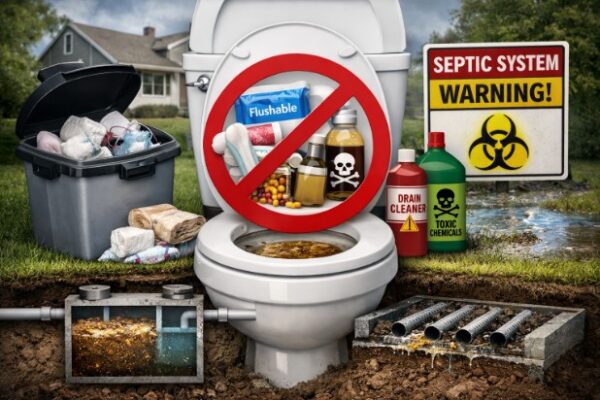
Southern California septic systems fail faster when toilets and drains become trash cans. A septic toilet is designed for human waste and toilet paper, not wipes, grease, or chemicals.
A short “do not flush” list prevents clogs, protects septic bacteria, and reduces the odds of a sewage backup.
When a home already shows warning signs like gurgling drains, slow flushing, or recurring odors, scheduling septic pumping early often stops a partial restriction from turning into a full backup, and a technician can confirm the correct next step during the same visit.
A septic system works like a small biological treatment plant. The septic tank separates solids from liquids, bacteria break down organic waste, and the drain field disperses treated effluent into the soil.
Non-degradable items, fats, oils, grease, and harsh chemicals disrupt that process. The result is predictable. Pipes clog, filters load up, sludge accumulates faster, and drain fields absorb less efficiently.
A septic toilet should flush only human waste and toilet paper. Many agencies summarize the rule as the “three P’s,” and the EPA’s SepticSmart poster lists common items that clog pipes and damage septic systems, including wipes, diapers, cotton products, floss, plastics, and medications.
A simple household rule prevents most septic clogs.
A guest-friendly rule works best when it fits on one line. Only toilet paper goes in the toilet.
Everything else goes in the trash. A visible bin with a lid prevents “accidental” flushing more reliably than any reminder speech.
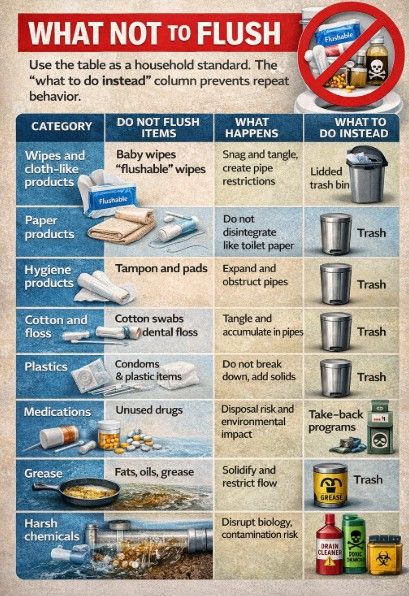
Use this table as a household standard. The “what to do instead” column prevents repeat behavior.
| Category | Do Not Flush Items | What Happens | What To Do Instead |
| Wipes and cloth-like products | Baby wipes and “flushable” wipes | Snag and tangle, create pipe restrictions | Lidded trash bin |
| Paper products | Paper towels and shop towels | Do not disintegrate like toilet paper | Trash |
| Hygiene products | Tampons and pads | Expand and obstruct pipes | Trash |
| Cotton and floss | Cotton swabs and dental floss | Tangle and accumulate in pipes | Trash |
| Plastics | Condoms and plastic items | Do not break down, add solids | Trash |
| Medications | Unused drugs | Disposal risk and environmental impact | Take-back programs |
| Grease | Fats, oils, grease | Solidify and restrict flow | Grease container |
| Harsh chemicals | Solvents and paint products | Disrupt biology, contamination risk | Hazardous waste disposal |
Septic backups start with simple physics. Many items do not break down like toilet paper. Some items tangle and snag. Some items float and accumulate.
Some items kill the bacteria that digest solids. The “flushable” label does not guarantee septic-safe behavior, and the EPA’s do-not-flush list still treats wipes as a common clog source because wipes do not disintegrate like toilet paper.
Clog makers share one trait. They stay intact long enough to catch on pipe bends and fittings.
A clog rarely starts as a full blockage. A clog usually starts as a snag. A snag becomes a restriction. A restriction becomes slow drains and gurgling. Continued flushing turns slow drainage into a backup.
A septic tank relies on bacteria to break down solids. Products that kill bacteria or change pH can reduce breakdown and increase sludge.
Local guidance commonly warns against sending hazardous chemicals into septic systems.
Medication disposal deserves special handling. Many agencies recommend take-back options instead of flushing for most medicines, and the LA County Sanitation District promotes no-drugs-down-the-drain disposal to keep drugs out of plumbing and waterways.
The FDA’s flush list applies only to specific medicines when take-back options are not readily available.
Lanik Septic Service helps prevent septic backups fast. Book septic pumping early if wipes or grease are causing slow drains. Contact us today.
If you’re ready to get started, call us now!
A septic failure usually follows one of three pathways. Physical blockage, solids overload, or chemical shock.
The item category predicts the failure mode, which is why a category-based list beats a generic warning.
Wipes, floss, and cotton products snag inside pipes and fittings. Those snags collect other debris. A small snag becomes a partial restriction.
Partial restriction leads to slow drains and gurgling. Continued flushing increases upstream pressure until the lowest fixture backs up, often a shower or tub.
Some systems show symptoms earlier because protective components catch debris before the drain field does.
Homes with filters and baffles can experience odor and slow drainage when filters become loaded.
Regular effluent filter cleaning reduces the risk of restriction, and a technician can confirm whether a clogged filter is the primary cause or a symptom of a larger downstream problem.
Solids overload happens when non-degradable materials accumulate in the tank. More solids mean less effective settling and shorter time to reach pump-out thresholds. Excess solids can also carry into downstream components, which stresses distribution and drain field performance.
Grease creates a similar problem through a different mechanism. Fats, oils, and grease can solidify in pipes, forming buildup that restricts flow.
Grease also increases scum formation and accelerates capacity loss. Penn State Extension guidance on septic-safe habits warns against sending fats, oils, and grease down drains, as they can contribute to clogs and stress the system.
Chemical shock happens when strong cleaners or solvents disrupt bacterial activity. Reduced bacterial activity slows the breakdown of solids.
Slow breakdown increases sludge accumulation, increases odor risk, and increases the chance that solids move into downstream components.
Persistent septic odors usually indicate restriction, venting defects, or drain field stress, and the University of Minnesota guidance on odor causes treats ongoing odor as a symptom that warrants investigation rather than a condition to ignore.
A “do not flush” list works only when a household also follows a “do this instead” plan. A household needs a bathroom trash plan, a kitchen grease plan, and a medication take-back plan. Households that skip the alternative disposal step tend to repeat the same habits.
A lidded trash can in every bathroom prevents most wipe and hygiene-product backups. Store wipes away from toilets, not on counters.
Bathroom rules that prevent clogs
A household checklist improves compliance because every person follows the same rules. Basic dos and don’ts: keep habits consistent across guests, kids, and short-term rental turnover.
Kitchen inputs drive sludge and scum. Two habits prevent most kitchen-driven septic stress. Scrape solids and capture grease.
Kitchen rules that protect septic systems
EPA septic care guidance emphasizes keeping grease and harsh chemicals out of drains, and a household that follows that principle prevents many restriction problems before they start. (epa.gov)
Most unused medicines belong in take-back programs, and California provides statewide take-back search options through the Board of Pharmacy take-back locator for common disposal needs.
When household hazardous waste enters plumbing, the risk shifts from “clog” to “contamination,” which is why municipal and county programs exist for drop-off.
A simple routine prevents impulsive flushing. Store take-back items in a marked container and schedule a monthly drop-off.
If odors or gurgling keep returning, schedule professional maintenance with Lanik Septic Service before restrictions become backups. Schedule an appointment now.
If you’re ready to get started, call us now!
Southern California homeowners often combine water-saving habits with periods of increased usage. Low-flow fixtures reduce dilution and change how solids move through plumbing. Weekend guests and house parties suddenly increase the load.
Those patterns can expose restrictions sooner, especially when a household flushes wipes or uses a garbage disposal heavily.
Guests feel what they think is normal. That includes wipes and hygiene products. More guests also means more water use. Higher solids plus higher flow make restrictions show up quickly.
Prevention comes from making the correct behavior easier than the wrong behavior. Place a visible lidded trash bin. Keep wipes out of sight. Stock the bathroom with essentials so the toilet isn’t used as a trash can.
Wipes create repeat clogs because wipes do not break down like toilet paper. The EPA’s SepticSmart guidance lists wipes as a do-not-flush item even when packaging claims otherwise.
A household that used wipes for years can still have accumulated material in plumbing or the tank. Symptoms matter more than history.
Early warning patterns often match “tank full” patterns even when the root cause is restriction, and tank-full signs help interpret whether slow drains reflect a full tank, a clog, or drain field stress.
Deep cleaning days create two risks. High water volume creates surges, and high chemical volume reduces bacterial performance.
A household can trigger odor and slow drains after heavy cleaning without any new physical “break.”
A safer strategy uses spacing and moderation. Spread water-heavy activities across days. Avoid chemical drain openers. Use normal household quantities of cleaners rather than repeated dosing.
When odors repeat after cleaning, the system may already be stressed. A service visit that includes inspection reduces guesswork, and professional maintenance clarifies what technicians typically evaluate during a preventive visit.
A homeowner protects the drain field by acting early. The drain field is expensive to restore once it fails, so “wait and see” often costs more than scheduled service.
A developing restriction usually shows up as a pattern, not a one-time event.
Schedule service soon when these symptoms repeat.
Alarm events deserve prompt attention because alarms often signal high water, pump issues, or abnormal conditions, and alarm steps help confirm what a homeowner should do safely before service arrives.
Same-day triggers involve contamination risk or system failure.
Stop water use and call the same day when these conditions occur.
When symptoms suggest restriction or overload, continuing to use water increases the chance of indoor overflow or surface discharge. A same-day response reduces cleanup risk and protects the property.
Pumping frequency depends on household size, tank size, and usage patterns. A schedule that matches actual load reduces solids carryover and reduces clog risk.
The California-focused guidance on pumping frequency helps homeowners align service timing with real usage rather than guessing.
Distribution problems can also mimic random symptoms. Uneven flow can overload one area of a drain field, leading to localized saturation and odor.
When a home shows recurring yard odor in the same zone, distribution box problems provide the failure patterns technicians commonly check.
A prevention plan works when it is simple enough to follow every day. Two bathroom rules and two kitchen rules prevent most septic problems caused by flushing.
Households that apply these habits reduce solids loading and reduce the odds of early system failure.
If a home already sees repeated symptoms, accumulated material may already exist in the plumbing or the tank. In those cases, trial-and-error often wastes time.
Recurring symptoms should trigger a proactive evaluation. The list of septic problem signs helps determine whether a pattern suggests routine maintenance or escalating failure risk, and acting earlier protects downstream components.
A septic system stays stable when the toilet stays simple. Human waste and toilet paper belong in the toilet.
Everything else belongs in the trash or a take-back program. When a household follows that rule consistently, clogs drop, odors decrease, and pump schedules become more predictable.
When warning signs appear, treat those signs as actionable data. Slow drains, gurgling, and recurring odors usually indicate restriction or overload, not a temporary smell. A homeowner who acts early protects the drain field and reduces total cost.
For sewage backups or wet yard areas, get emergency septic service from Lanik Septic Service to limit damage. Contact us now.
A septic toilet should handle only human waste and toilet paper. Wipes, paper towels, hygiene products, floss, grease, chemicals, and medications commonly cause clogs or disrupt tank bacteria, increasing the likelihood of backups. Keep a lidded trash bin in every bathroom to maintain consistent disposal.
“Flushable” labels do not guarantee septic-safe breakdown. Many wipes stay intact, get snagged in pipes, and cause blockages that lead to slow drains and backups. Replace wipe flushing with a bathroom trash routine, and treat recurring gurgling as a warning sign.
Grease and oil can cool, congeal, and coat pipes, narrowing flow and increasing the risk of clogs. Grease also adds to the scum layer in the tank, so the capacity drops faster. Scrape plates first, then dispose of the grease in a sealed container in the trash.
A partial clog often shows up as repeated slow drains, toilet gurgling, or sluggish flushing across multiple fixtures. Early action prevents escalation, and effluent filter cleaning can reduce restriction pressure before symptoms become a backup.
Most medicines should not be flushed because disposal can create environmental risk and does not help septic performance. Use no-drugs-down-the-drain guidance and take-back options to keep pharmaceuticals out of plumbing.
Yes. Caustic drain openers and heavy chemical use can disrupt septic bacteria and slow solids breakdown, increasing the risk of sludge and odor. Use routine cleaners in normal amounts, avoid chemical “shock” cleaning, and follow septic maintenance tips for safer habits.
Treat the problem as urgent when sewage backs up indoors, multiple fixtures fail at once, or wastewater surfaces in the yard. Stop using water immediately and follow emergency septic service steps to limit damage and exposure to contamination.
Prevention improves when the bathroom setup makes the right behavior easy. Place a lidded bin in every bathroom, remove wipes from sight, and standardize household rules using dos and don’ts so guests follow the same disposal habits.
Reviews
“This company is BEYOND helpful. Great customer service in the office, hard working employees in the field, reliable and very trust worthy. Having to replace an entire septic system is not something we ever intended on doing, but had to. If it hadn't been for Lanik Enterprises, Inc, I don't know where we would be. I HIGHLY RECOMMEND Lanik Enterprises!”
- Chanel Leos
