

License A & C-42 #458947

Originally published: October 2026

A septic alarm that returns after a pump-out is a second failure, not a leftover from the first one.
Pumping empties the primary tank, while the alarm float sits in the pump chamber or dose tank on systems built with one, so upstream work doesn’t reset a downstream level.
Recurring alarms trace to a disturbed float, a starved or failed pump, a loaded outlet screen, or a drainfield that will not accept effluent. Each has a different fix, and a septic repair visit identifies which one within a single service call.
A repeat alarm after a pump-out rarely clears on its own. Lanik Septic Service isolates float, pump, and drainfield causes across Southwest Riverside County — schedule service.
The alarm returns because pumping and alarm monitoring happen in two different places. A pump truck services the primary treatment tank, where solids settle, and sludge accumulates.
The high-water float that triggers the alarm hangs in the pump chamber, dose tank, or lift station downstream of that tank—the vessel that holds effluent until a pump sends it uphill to the disposal field.
Emptying the upstream tank lowers nothing in the downstream chamber. Household water resumes flowing within minutes of the truck leaving, the chamber refills on its normal cycle, and the float returns to the level it occupied before the appointment.
Homeowners who expect tank pumping to reset the alarm are working from a reasonable assumption that the plumbing does not support.
A brief alarm during the visit itself is unremarkable, since drawdown and refill move liquid past float set points.
An alarm that lasts through a day of ordinary household use warrants a service call rather than more waiting, because the condition keeping the float up is no longer the appointment.
Six conditions account for most repeat alarms following service. The table below maps each to what a homeowner would observe and what it takes to resolve it; the signatures narrow the diagnosis rather than settle it, and a technician confirms which applies on site.
| Cause | Typical signature | What resolves it |
| Float tangled or pinned against the pump or tank wall | Alarm holds steady; pump never audibly cycles | Technician repositions and re-secures the float assembly |
| Pump chamber not included in the service order | Alarm resumes soon after the truck leaves, often the same day | Separate pump-out of the dose chamber or lift station |
| Solids carried onto the outlet screen | Slow drains alongside the alarm, worsening over several days | Screen removal, rinse back into the tank, cause investigation |
| Pump impeller obstructed | Pump runs, but the liquid level does not drop | Pump pulled, cleared or replaced, check valve inspected |
| Breaker tripped or cord disconnected during access | Panel dark or breaker in the off position | Electrical diagnosis by a qualified technician |
| Drainfield refusing effluent | Alarm returns later, often with wet ground above the field | Field evaluation, permit review, repair or replacement planning |
Solids carryover deserves attention in Southwest Riverside County, where long service intervals allow deep sludge layers to form. Evacuating a tank agitates that layer, and suspended particles can migrate toward the outlet as the tank restabilizes.
The effluent filter catches them and may blind over, restricting flow and producing an alarm that seems unrelated to a tank that was just emptied.
If you’re ready to get started, call us now!
The alarm means different things depending on what the control panel monitors, and pumping reaches only one of the three configurations below.
| System type | What the alarm monitors | Does a pump-out address it |
| Gravity system with outlet screen alarm | Liquid level backing up behind a blinded screen | Partially — only if the screen is cleaned and the cause corrected |
| Pump chamber, dose tank, or lift station | High-water float above the pump start float | No — the chamber is a separate vessel from the tank serviced |
| Aerobic treatment unit | Aerator function, dosing timer, and liquid level together | No — a failed blower keeps the alarm lit at any liquid level |
Homeowners with aerobic treatment units encounter this mismatch most often. The panel on those systems reports an air supply failure and a high-water condition through the same light and buzzer, so an owner who books a pump-out to silence an aerator fault pays for a service that cannot reach the problem.
Riverside County issues annual operating permits for these systems through the Department of Environmental Health, which also registers the service providers qualified to work on them.
Four checks are safe to do from outside the system and narrow the diagnosis before a technician arrives:
Three actions are never safe. Opening a tank or riser lid exposes a hazardous atmosphere: OSHA classifies tanks as permit-required confined spaces because they contain or can develop atmospheres that incapacitate an entrant without warning.
Reaching into a chamber to free a float carries the same exposure plus a drowning hazard.
Resetting a breaker that trips again pushes current through a fault that has already declared itself, and a shorted pump motor or a flooded panel is diagnosed with instruments rather than with a switch.
Anyone facing an active sewage backup inside the house has moved past checklist territory and needs dispatch.
Standing water over a disposal field signals contamination risk, not inconvenience. Lanik Septic Service offers same-day dispatch across North San Diego County when conditions escalate — request an assessment.
Timing narrows the field rather than settling it. Component faults tend to surface quickly, because nothing has to fill before the condition exists — a float moved during the visit, or a pump obstructed by material loosened from the sludge layer, produces an alarm as soon as the system cycles.
Disposal problems tend to surface later, since the chamber must fill, the pump must dose, and the field must refuse that dose before levels climb back to the float.
Water use, chamber capacity, pump output, weather, and intermittent electrical faults all shift that interval, so timing indicates where to look first rather than what to replace.
An alarm that appears several days after a pump-out, in dry weather, with a pump that audibly runs, is consistent with a field no longer absorbing at its design rate—and worth checking before swapping a float or pump.
Recognizing the drainfield failure pattern matters because the pump then cycles more often and runs longer on each cycle, adding wear that a component replacement will not undo.
Distribution faults produce a similar delay. A settled or blocked distribution box sends the full dose into one lateral while the others sit idle, overloading a fraction of the available absorption area.
Surfacing effluent moves the situation into regulatory territory: Riverside County’s environmental health bulletin on onsite wastewater treatment systems states that allowing septic effluent or graywater to discharge onto the ground surface violates County Ordinance No. 650, and directs owners to have the tank pumped and the system evaluated immediately when wastewater reaches the surface.
Diagnosis follows the water, in order. A technician confirms panel power and float continuity, observes an actual pump cycle to see whether the level drops, inspects the outlet screen and baffle for carryover, and then evaluates whether the field accepts the dose.
That sequence separates a twenty-minute float correction from a field evaluation before proposing any excavation.
Licensing sets who may perform the work. The California Contractors State License Board defines the sanitation system contractor classification as covering the fabrication and installation of cesspools, septic tanks, and other sewage disposal structures.
CSLB’s guidance for building officials also states that A General Engineering, C-36 Plumbing, and C-42 Sanitation System licenses are each appropriate classifications for installing or repairing septic systems, so more than one license class can lawfully perform this work.
Riverside County adds a separate requirement on top of state licensing. A Qualified Service Provider registered with the county Department of Environmental Health must sign certification of an existing system, and that certification forms part of the submittal package for a construction permit to repair or modify an existing system.
Work that replaces, enlarges, or modifies a septic tank, treatment unit, or dispersal system falls under that permit process. Owners scheduling septic inspections ahead of a property sale meet both requirements at once.
Permit processing shapes the timeline as much as the repair. Lanik Septic Service handles permitting in-house across its Riverside County service area, which removes the handoff between a diagnosing contractor and a separate permit expediter when a field repair becomes necessary.
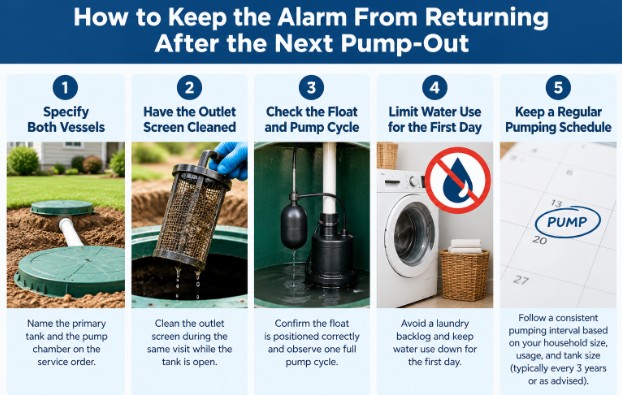
Prevention is mostly scheduling and scope, decided before the truck is booked:
Homeowners in Murrieta, Temecula, Menifee, and Fallbrook on older systems benefit from recording each service date and the condition noted, since a technician diagnosing a repeat alarm works faster with a service history than without one.
Owners unsure whether the system even has a pump chamber can settle that question during a system troubleshooting visit.
Is it normal for a septic alarm to sound right after pumping?
A brief alarm during or immediately after a pump-out is common, because the truck moves liquid levels and the pump chamber refills as household water returns. An alarm that lasts through a full day of normal use points to a component or disposal issue instead.
Does pumping the septic tank empty the pump chamber too?
Not always. Pumping companies quote by the tank, and the dose chamber or lift station sits separately downstream. A crew that services only the primary tank leaves the pump chamber untouched, so an alarm tied to that chamber keeps sounding after the visit.
Can a pump-out knock the float switch out of position?
It can. Falling liquid levels and suction can draw a tethered float against the pump, the intake screen, or the tank wall. A float held down never starts the pump; a float held up runs it dry or holds the alarm on.
Why does the alarm return a few days after pumping?
A delayed return more often involves disposal than the tank. Effluent that cannot soak into a saturated or failing drainfield backs up toward the pump chamber, refilling it faster than the pump empties it, and the high-water float trips again.
Does silencing the alarm fix anything?
Silencing stops the buzzer and nothing else. The red indicator stays lit while the high-water condition holds, and the float remains above its set point. Silencing without reducing water use only removes the single warning a homeowner gets before a backup reaches the house.
Can a clogged effluent filter set off the alarm after a pump-out?
It can. Pumping disturbs settled sludge, and suspended solids can load the outlet screen. A blocked screen slows flow out of the primary tank, so gravity systems back up and pumped systems starve, both of which register as an alarm condition.
Should the breaker be reset more than once?
No. A breaker that trips again can indicate a shorted pump motor, damaged cord, or water inside the control panel. Repeated resets push current through a fault that a licensed septic or electrical contractor should test and clear first.
Why does an aerobic unit alarm stay on even though the tank was just pumped?
Aerobic treatment unit panels watch the aerator as well as the water level. A failed blower keeps the alarm lit regardless of how much liquid the truck removed, because pumping does not restore the air supply the treatment process depends on.
Does heavy rain explain an alarm that started after pumping?
Rain explains a short-lived alarm during a storm. Groundwater entering through a cracked lid, an unsealed riser seam, or a damaged tank raises levels and can keep tripping the float after the ground dries, pointing to repair rather than weather.
Who is qualified to service a septic alarm in Riverside County?
California recognizes A General Engineering, C-36 Plumbing, and C-42 Sanitation System licenses for septic installation and repair. Riverside County separately requires a Qualified Service Provider registered with its Department of Environmental Health to certify an existing system.
Wet ground over a disposal field and a returning alarm together signal a system losing capacity. Lanik Septic Service diagnoses the cause across Temecula, Murrieta, and Fallbrook — book an evaluation.
Reviews
“This company is BEYOND helpful. Great customer service in the office, hard working employees in the field, reliable and very trust worthy. Having to replace an entire septic system is not something we ever intended on doing, but had to. If it hadn't been for Lanik Enterprises, Inc, I don't know where we would be. I HIGHLY RECOMMEND Lanik Enterprises!”
- Chanel Leos
