

License A & C-42 #458947

Originally published: May 2026
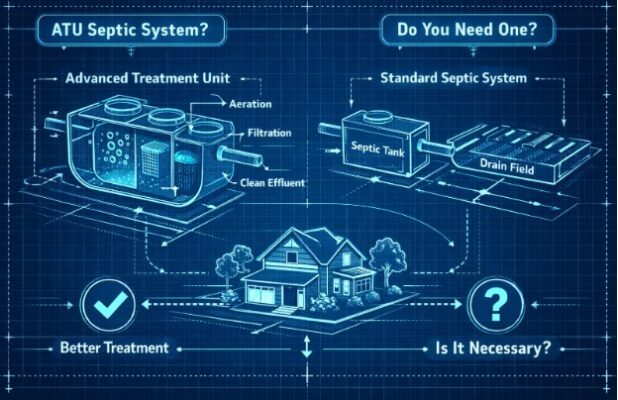
An advanced treatment unit (ATU) is a small-scale, on-site wastewater system that uses aerobic bacteria—supported by continuous aeration—to process household sewage to a higher standard than a conventional septic tank.
The result is cleaner effluent that meets stricter environmental and regulatory thresholds before it reaches the soil.
Southern California homeowners in Riverside County and surrounding areas most often encounter ATU requirements on small rural lots, properties near sensitive water resources, and septic installation or replacement projects where a failed conventional system cannot be rebuilt the same way.
If a site evaluation or permit review has flagged an ATU for your property, understanding how the system works, what it costs, and what actually triggers the requirement will help you move forward with confidence.
An advanced treatment unit is an on-site wastewater treatment system that injects air into the treatment chamber, creating an oxygen-rich environment where aerobic bacteria digest organic matter more quickly and thoroughly than in the anaerobic process of a conventional septic tank.
The effluent leaving an ATU is substantially cleaner before it reaches the soil or dispersal field, which is precisely why regulators require these systems on sites where standard tank output would exceed what the soil can safely filter.
You may also see the technology referred to as an aerobic treatment unit, an aerobic septic system, or an advanced wastewater treatment system (AWTS), depending on the jurisdiction. The core process is identical across those labels. An ATU is not a premium upgrade or cosmetic improvement.
It is a fundamentally different treatment approach, required in specific situations where a conventional system cannot perform safely, given the site conditions or regulatory framework in Southern California.
The term surfaces in a few predictable contexts: county site evaluations, failed percolation tests, replacement permits for failed systems, and new construction permits on challenging lots.
In Riverside County and surrounding Southern California areas, ATU requirements frequently apply to properties with poor soil percolation, shallow bedrock, high water tables, or proximity to streams and groundwater protection zones.
If your permit application returns with ATU language in the conditions, the county is telling you that a standard system does not meet the treatment threshold for your specific parcel.
Many jurisdictions require that ATUs meet NSF/ANSI 40 standards, though requirements vary by county and local health department rules.
Under NSF/ANSI Standard 40, Class I systems must achieve a CBOD5 of 25 mg/L or less and total suspended solids (TSS) of 30 mg/L or less — meaning the water leaving the system meets federal secondary wastewater treatment guidelines.
Some jurisdictions in Southern California, particularly those near water-supply watersheds, require NSF/ANSI 245 certification, which includes nitrogen-reduction standards. When a contractor recommends a specific ATU model, asking about its NSF certification tier is a reasonable and informed question.
If you’re ready to get started, call us now!
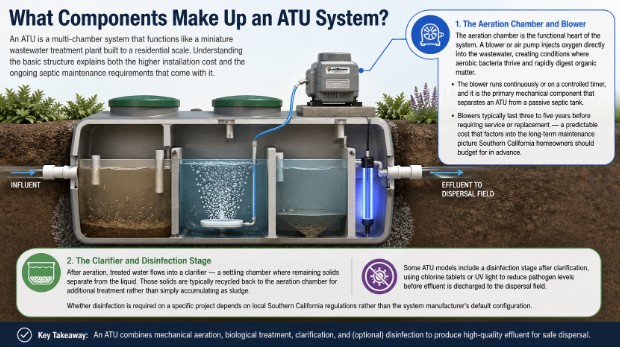
An ATU is a multi-chamber system that functions like a miniature wastewater treatment plant built to a residential scale. Understanding the basic structure explains both the higher installation cost and the ongoing septic maintenance requirements that come with it.
The aeration chamber is the functional heart of the system. A blower or air pump injects oxygen directly into the wastewater, creating conditions where aerobic bacteria thrive and rapidly digest organic matter.
The blower runs continuously or on a controlled timer, and it is the primary mechanical component that separates an ATU from a passive septic tank.
Blowers typically last three to five years before requiring service or replacement — a predictable cost that factors into the long-term maintenance picture Southern California homeowners should budget for in advance.
After aeration, treated water flows into a clarifier — a settling chamber where remaining solids separate from the liquid. Those solids are typically recycled back to the aeration chamber for additional treatment rather than simply accumulating as sludge.
Some ATU models include a disinfection stage after clarification, using chlorine tablets or UV light to reduce pathogen levels before effluent is discharged to the dispersal field.
Whether disinfection is required on a specific project depends on local Southern California regulations rather than the system manufacturer’s default configuration.
An aerobic treatment unit produces cleaner effluent, requires electricity to operate, and demands more frequent professional servicing than a conventional septic tank.
The four practical distinctions that matter most to Southern California homeowners are effluent quality, space requirements, power dependency, and maintenance intensity.
| Factor | ATU (aerobic) | Conventional septic (anaerobic) |
| Oxygen use | Continuous aeration via blower | Oxygen-free, passive process |
| Effluent quality | Lower BOD and TSS, cleaner output | Higher organics rely on soil for final treatment |
| Power dependency | Requires electricity for the blower and pumps | Gravity-based, no power needed |
| Maintenance | Annual service contract, mechanical inspections | Periodic pumping, no moving parts |
| Best suited for | Small lots, poor soils, sensitive areas | Larger lots with adequate soil conditions |
The cleaner effluent an ATU produces has a direct practical consequence for the sizing and positioning of your dispersal system.
Higher-quality effluent can be managed through smaller or more sensitive leach fields, which is exactly why Southern California regulators require ATUs on lots where a conventional system’s output would overwhelm the soil’s natural filtration capacity.
On tight lots or properties with soil that percolates too quickly or too slowly, the ATU is what makes the math work for a functional dispersal system.
For more on how septic system costs shift when site conditions require enhanced treatment, review what drives the total project price before committing to a budget.
A standard septic tank has no moving parts and needs no electricity. An ATU has a blower, pumps, and often disinfection hardware — all of which require periodic inspection and servicing.
Better effluent quality comes with higher installation costs, a required annual service contract, and roughly $5 to $15 per month in electricity.
For Southern California properties where an ATU is mandated by the county, there is no workaround. For properties where it is presented as optional, the decision warrants a genuine cost-benefit conversation with a licensed C-42 contractor who understands your local requirements.
If you’re ready to get started, call us now!
A Southern California property requires an ATU when soil conditions, lot size, or proximity to sensitive water resources prevent a conventional septic system from performing safely.
The clearest way to know whether an ATU is genuinely required is to understand the specific conditions and regulatory triggers that put it on the table — not to accept a recommendation at face value.
Properties with clay-heavy soil, high water tables, or shallow bedrock commonly fail standard percolation tests. When soil cannot provide adequate final filtration on its own, county regulators require a treatment system that produces cleaner effluent before it reaches the ground.
Percolation rates at the extremes — either too fast with certain sandy soils or too slow with clay — can both trigger enhanced treatment requirements, though the specific thresholds vary by jurisdiction across Southern California.
Small rural lots that cannot physically accommodate the setback distances required for a conventional leach field are another common trigger, particularly in the mountainous and foothill communities of Riverside County.
Some Southern California jurisdictions write ATU requirements directly into permit conditions for properties within a set distance of streams, lakes, or designated groundwater protection zones.
Riverside County regulates advanced treatment units (ATUs) under its Local Agency Management Program (LAMP), with specific approval requirements for ATU models and installation processes.
Homeowners can reference current rules on the Riverside County Environmental Health septic systems page for details. Requirements in neighboring counties — including San Diego County — follow their own frameworks, so working with a contractor familiar with each county’s current rules is the most reliable way to navigate the permit pathway accurately.
If a conventional septic system has failed and site conditions have not improved since the original installation, the county often requires an ATU as part of the replacement permit approval. This scenario catches homeowners mid-project when they hired a contractor who did not flag this possibility up front.
Knowing in advance that your septic repair or replacement may require enhanced treatment — not just a like-for-like swap — allows accurate budgeting and prevents delays that stall the job.
For a clear picture of what septic repair costs look like when a failing system triggers an upgrade requirement, reviewing regional cost data before your permit review is a practical first step.
ATU installation in Southern California typically runs $10,000 to $20,000 as of 2026, compared to $3,000 to $10,000 for a conventional septic system. The numbers below are planning estimates drawn from regional project experience.
Actual costs vary by lot conditions, ATU model, site preparation requirements, and county permit fees — treat these as ranges rather than fixed quotes.
The cost gap between an ATU and a conventional system reflects the added components — multi-chamber tank, blower, controls — as well as the more complex permitting and inspection process that an ATU installation requires.
In Southern California, site preparation costs, soil work, and county-specific permit fees can push project totals toward or past the top of that range, particularly on lots with difficult access or significant grading requirements. For context on how septic installation costs break down across project types in the region, comparing line items before requesting quotes will sharpen your budget.
The installation cost is the larger upfront number, but ongoing expenses are what Southern California homeowners most often underestimate when budgeting for an ATU:
These are predictable, manageable costs when budgeted correctly. A well-maintained ATU is a durable, long-term system. The key is knowing these costs exist before you commit — not discovering them at the first service visit.
For ways to reduce septic system costs over the long term, proactive maintenance scheduling consistently outperforms reactive repair spending.
The decision framework is simpler than the technical detail suggests. A few targeted questions will tell you whether an ATU is a genuine requirement for your Southern California property or a recommendation worth probing further.
Start with the basics before accepting any recommendation at face value:
These four questions will quickly reveal whether you are dealing with a genuine site requirement or an upsell. If you are unsure whether your lot’s soil conditions support a conventional system or require advanced treatment, a formal site assessment by a licensed contractor is the only reliable way to determine the answer.
NSF certification indicates that an ATU meets specific performance thresholds within its class, but the certification tier is only part of the equation.
What varies far more from project to project is the licensed contractor’s experience with your county’s permit process, their working relationship with county inspectors, and their ability to move a permit application through without delays or corrections.
The ATU brand matters far less than the licensed contractor’s experience with your county’s permit process.
At Lanik Septic Service, our team handles ATU installations across southwest Riverside County and north San Diego County with an in-house permit processor who works with these county departments daily. That local knowledge means fewer mid-project surprises, approvals that move on schedule, and a one-year labor warranty on the completed work.
For Southern California homeowners navigating an ATU requirement for the first time, contact Lanik Septic Service for a consultation — we will give you a straight answer on what your property actually needs and what it will cost to do it right.
What is an advanced treatment unit for septic systems?
An advanced treatment unit (ATU) is an on-site wastewater treatment system that uses aerobic bacteria, supported by continuous aeration, to process household sewage to a higher standard than a conventional septic tank. The system produces cleaner effluent that can be safely dispersed on Southern California sites where standard systems would not meet regulatory or environmental requirements.
How is an ATU different from a conventional septic system?
A conventional septic system relies on anaerobic decomposition and the soil’s natural filtration capacity to complete the treatment process. An ATU actively injects air into the wastewater, producing effluent that meets stricter quality thresholds before it reaches the drain field. The septic systems guide covers how both system types function in Southern California conditions.
Do all properties need an advanced treatment unit?
No. ATUs are required when site conditions — poor soil percolation, high water tables, shallow bedrock, small lot size, or proximity to sensitive water resources — prevent a conventional system from performing adequately. Whether your Southern California property requires one is determined by a formal site assessment and your county’s permit review, not by a general preference or contractor’s default recommendation.
What does an ATU cost to install and maintain in Southern California?
Installation typically ranges from $10,000 to $20,000, compared to $3,000 to $10,000 for a conventional system. Annual maintenance costs — including service contracts, electricity, pumping, and blower replacement every three to five years — generally total $800 to $1,600 per year, depending on your system and local requirements.
Is a service contract required for an ATU?
In many Southern California jurisdictions, yes. Riverside County requires proof of regular servicing as a condition of the installation permit under its LAMP program. Requirements vary by county, so confirm the specifics with your local health department or a licensed septic contractor familiar with your county’s current rules.
What happens if a failing septic system requires an ATU replacement?
If a conventional system has failed and site conditions have not improved, county regulators typically require an ATU replacement permit rather than a like-for-like swap. Homeowners who understand this before the permit review begins can budget accurately and avoid delays. Review signs of septic tank problems early to maximize lead time before the process begins.
How long does an ATU system last?
A well-maintained ATU typically lasts 20 to 30 years, comparable to a conventional septic system. The blower — the primary mechanical component — requires replacement every three to five years. Consistent annual servicing, as required by Riverside County under its LAMP program, is the single most reliable factor in reaching the upper end of that lifespan.
Can a conventional septic system be converted to an ATU?
A direct conversion is rarely possible because an ATU requires a multi-chamber tank, a dedicated blower, and often a reconfigured dispersal field. Most ATU projects on properties with existing conventional systems involve full replacement rather than modification. A licensed contractor familiar with Riverside County’s permit requirements can assess whether your site and existing infrastructure support any shared components.
Reviews
“This company is BEYOND helpful. Great customer service in the office, hard working employees in the field, reliable and very trust worthy. Having to replace an entire septic system is not something we ever intended on doing, but had to. If it hadn't been for Lanik Enterprises, Inc, I don't know where we would be. I HIGHLY RECOMMEND Lanik Enterprises!”
- Chanel Leos
