

License A & C-42 #458947

Originally published: October 2026
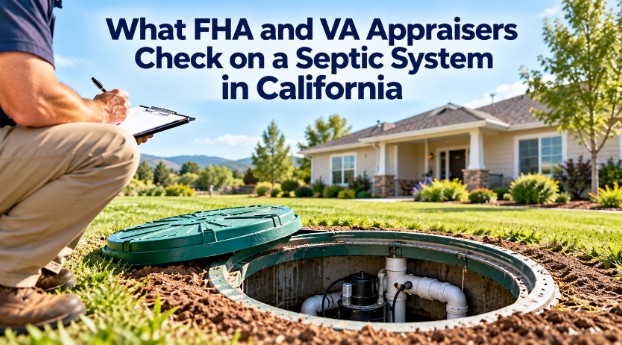
An FHA or VA appraiser does not inspect a septic system. The appraiser looks for signs of failure or surface evidence of malfunction and reports what they can observe from the surface.
Whether that observation becomes a required document depends on the loan program’s rules, the county’s program, the lender’s conditions, and the purchase contract—four separate decision-makers that transactions routinely treat as one.
In Riverside and San Diego Counties, the document that resolves the county side is a septic certification performed by a provider the county recognizes.
A septic condition discovered late can reshape a closing schedule. Lanik Septic Service performs inspections and certifications across Riverside and North San Diego Counties — book an appointment.
No, and the distinction matters because agents often expect a document and instead receive a condition. An appraisal estimates value and assesses whether the property meets the program’s requirements. It is a visual assessment of the property as a whole, not a system evaluation performed with equipment.
On a septic property, the appraiser looks. FHA’s Single Family Housing Policy Handbook 4000.1 directs the appraiser to examine a septic system for signs of failure or surface evidence of malfunction, and to require repair or further inspection where deficiencies are readily observable.
The appraiser does not open lids, measure sludge, or run flow tests. Those steps belong to the professional who performs the evaluation, and the two roles are often confused within the same file.
The second half of the FHA rule is where most California transactions land. FHA treats an individual sewage system as acceptable when the local health authority accepts it, which shifts the substantive question from a federal standard to a county one.
The handbook publishes no list of approved septic designs, so the county’s program supplies the answer. Buyers comparing certification and inspection are looking at the two halves of that structure.
Observable conditions drive the outcome. The table maps what an appraiser can see from the surface to what it generally leads to in an FHA file.
| What the appraiser can observe | What it generally leads to |
| No visible problems, no applicable local requirement | No septic condition added by the appraiser |
| Wet or spongy soil, effluent at grade, odor over the field | A call for repair or further inspection before closing |
| A local health authority requirement that applies to the area | Documentation collected to establish acceptability |
| A recorded history of system problems on the property | Documentation confirming current function |
| A private well on the property alongside the septic system | Attention to separation distances between the well and sources of pollution |
Effluent at the surface carries a second consequence in Riverside County, separate from the loan.
The county’s environmental health bulletin on onsite wastewater treatment systems states that allowing effluent or graywater to discharge onto the ground surface violates County Ordinance No. 650, and directs owners to have the system pumped and evaluated without delay.
The lending condition and the code matter arise from the same observation but are enforced by different parties.
Separation distance applies where the property also has a private well. FHA sets minimum distances between a private well and sources of pollution, including the septic tank and the disposal field, and local requirements govern when they exceed the federal minimums.
Properties across Anza, Aguanga, and rural Fallbrook often have both systems on one parcel, which brings those measurements into the appraisal conversation.
If you’re ready to get started, call us now!
VA files follow a different structure under different authority. Minimum property requirements for VA-guaranteed loans are established by regulation — 38 CFR 36.4351 provides that no loan for the purchase or construction of residential property is eligible for guaranty unless the property conforms to the standards of planning, construction, and general acceptability prescribed by the Secretary — with the operating detail carried in Chapter 12 of the VA Lender’s Handbook, Pamphlet 26-7.
The governing standard there is adequacy rather than paperwork. An individual sewage disposal system must be adequate in size, properly operated and maintained, and must not become a menace to public health. The appraiser assesses this performance requirement during the visit.
Health authority approval is conditional, not automatic. VA calls for it on proposed construction, and on new or existing construction when the appraiser identifies a system problem or when the area is known to have soil percolation problems. An existing property with no observed issue, in an area without known percolation problems, does not automatically trigger a health authority requirement under VA rules—which is the opposite of what many transactions assume.
Lender overlays and purchase contracts can still require documentation regardless, and confirming which of those applies belongs with the loan officer on the file.
When either program does route the question to the county, the county program determines what satisfies it.
Riverside County’s Department of Environmental Health requires certification of an existing system submitted to the department to be performed by a registered Qualified Service Provider or Professional Registrant, and treats work that replaces, enlarges, or modifies a tank, treatment unit, or dispersal system as a major repair requiring the county’s construction permit process.
Aerobic treatment units carry an annual operating permit.
That registration requirement is the detail most often missed. A general home inspector can report on a septic system’s apparent condition, and that report has value for a buyer, but it is not the document the county’s program contemplates.
Ordering the wrong evaluation late in a contingency period means ordering the right one afterward.
San Diego County administers its own onsite wastewater program with its own provider requirements and terminology, which is why properties in Fallbrook, Bonsall, and Valley Center follow a different path than properties a few miles north.
Confirming which county’s program applies before scheduling avoids a second visit, and service across both counties keeps one contractor on the file.
Transactions routinely collect the wrong paperwork because the names sound interchangeable. They are not, and the certification row varies by county.
| Document | Who produces it | What it establishes |
| Appraisal report | The FHA- or VA-assigned appraiser | Value, and whether observable conditions require repair or further inspection |
| Septic inspection report | A licensed septic contractor | The system’s observed condition and function on the date of the visit |
| Septic certification | A provider registered under the applicable county’s program — in Riverside County, a QSP or PR | That the system met that county’s standards when evaluated, under that county’s terminology |
| Pumping receipt | The pumping contractor | That solids were removed on a date, and nothing beyond that |
| Construction permit and final | The county, following a permitted repair | That corrective work was approved and inspected |
A pre-listing evaluation produces the second row before an offer exists, which is the argument for ordering one early. Sellers who wait learn the requirement at the same moment as the buyer, with contingency dates already set.
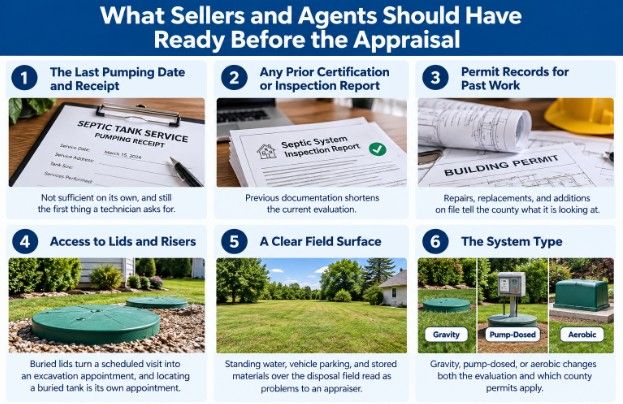
Six items cover most of what a lender, appraiser, or county reviewer asks for:
Maintenance history carries weight beyond any single transaction. The EPA advises inspection of a typical household system at least every three years, with pumping frequency set by household size, wastewater generated, solids content, and tank size, per its septic maintenance guidance.
Sellers in Temecula and Murrieta preparing to list can fold an evaluation into scheduled service.
If an evaluation finds a fault, the repair work and the permit path determine how long the correction takes.
Does an FHA appraiser inspect the septic system?
No. The appraiser observes the property and checks for visible signs that the septic system may be failing or malfunctioning. If the appraiser identifies an observable concern, they may require repairs or a separate septic inspection by a qualified professional.
Does FHA always require a septic inspection in California?
Not automatically. Handbook 4000.1 ties acceptability to the local health authority, so what gets ordered depends on the county’s program, any lender conditions on the file, and the purchase contract. An appraiser reporting evidence of failure adds its own requirement.
Does VA require local health authority approval on every septic property?
No. VA requires health authority approval for proposed construction and for new or existing construction when the appraiser identifies a problem or the area is known to have soil percolation problems. Lender overlays can add requirements separately.
What is the difference between an appraisal and a septic certification?
An appraisal estimates value and assesses program requirements. A septic certification is a separate document produced after a system evaluation, stating that the system met the county’s standards on the inspection date. A file may contain both.
Who can perform a septic certification in Riverside County?
Riverside County requires certification of an existing system submitted to the department to be performed by a registered Qualified Service Provider or Professional Registrant. A general home inspector’s report is not that document, and San Diego County runs its own program.
What happens if the appraiser notices wet ground over the drain field?
Surface evidence of malfunction leads the appraiser to call for repair or further inspection. In Riverside County, surfacing effluent is separately a code violation that the Department of Environmental Health directs owners to address without delay.
Does a recent pumping receipt satisfy a lender?
Rarely on its own. A receipt documents that solids were removed on a date; it says nothing about tank integrity, drainfield performance, or county compliance. County programs and lender conditions generally require an evaluation-based document.
How long does a septic certification stay valid for a sale?
No universal period applies. The county program, the lender, and the purchase contract set validity, and many transactions treat a certification as current only when completed during the active escrow or shortly before it.
Can a failing system be repaired during escrow?
Often, though, the timeline is the constraint. Repairs that replace or modify a tank, treatment unit, or dispersal system go through the county’s construction permit process, and permit review, the work, and re-evaluation each take time.
Should sellers order a certification before listing?
Ordering early converts a possible surprise into a scheduling decision. A seller holding a current evaluation knows what the appraiser will see, can complete repairs without contingency pressure, and can provide documentation to buyers on request.
Confirming what a specific file requires is faster than reacting to it later. Lanik Septic Service performs inspections and certifications across Temecula, Murrieta, and Fallbrook — schedule a certification.
Reviews
“This company is BEYOND helpful. Great customer service in the office, hard working employees in the field, reliable and very trust worthy. Having to replace an entire septic system is not something we ever intended on doing, but had to. If it hadn't been for Lanik Enterprises, Inc, I don't know where we would be. I HIGHLY RECOMMEND Lanik Enterprises!”
- Chanel Leos
