

License A & C-42 #458947


New construction of a septic system in Riverside County requires a percolation report, a signed OWTS design plan from a Professional of Record, and a building permit before any ground is broken.
Lanik Septic Service, a Temecula, California, C-42-licensed septic installation contractor holding License #458947, installs more than 200 complete septic systems per year throughout Southwest Riverside County.
Most new construction installations run $8,000–$20,000 and take four to eight weeks from permit submission to final inspection, based on general contractor experience in the region.
Waiting on permits while your build stalls costs money every week. Get your new construction septic scoped and submitted early — the firm serves builders, developers, and owner-operators across all of Southwest Riverside County with permit-ready OWTS plans and same-crew installation.
New construction septic installation in Riverside County requires three documents before the Riverside County DEH issues a construction permit: a percolation report including three sets of detailed plans signed by a Professional of Record registered with the department, a floor plan drawn to scale of all structures the system will serve, and documentation of established water service — an approved water bill or utility plan confirming active service to the project.
A percolation report documents soil absorption rates across the subject parcel to determine drain field sizing and placement.
The Riverside County DEH requires percolation tests to be performed by a registered Professional of Record — a licensed civil engineer, geologist, or environmental health specialist registered with the department under Riverside County Ordinance 650 (2022).
Percolation results directly determine whether a conventional system or an alternative treatment system is required for the parcel.
A building permit from the local building and safety agency is required before the Riverside County DEH issues a septic construction permit for new installations.
Builders who submit septic permit applications before securing the building permit face automatic rejection and restart the queue. The firm coordinates permit sequencing for builders throughout Southwest Riverside County to prevent such delays.
Riverside County approves two categories of onsite wastewater treatment systems for new construction under the county’s LAMP (2022): conventional gravity-fed systems and alternative treatment systems.
The percolation report determines which category applies to a given parcel — conventional systems are permitted where soil absorption rates meet county minimums, and ATUs are required where soil conditions prevent conventional installation.
A conventional gravity-fed septic system moves wastewater from the structure through a septic tank — where solids settle and liquids separate — and into a drain field of perforated pipes buried in gravel trenches.
Riverside County Ordinance 650 (2022) sets minimum tank sizing based on bedroom count and prohibits leach lines under driveways or within setback distances from wells, property lines, and structures. Conventional systems carry lower installation costs and simpler maintenance requirements than ATUs.
An alternative treatment system (ATU) is required on parcels where soil percolation rates fall outside the range that supports conventional drain field performance.
ATUs installed in Riverside County require an annual operating permit through the Riverside County DEH in addition to the standard construction permit.
Builders selecting a parcel in areas with expansive clay soils — common in parts of Southwest Riverside County, including portions of Anza, Mountain Center, and Aguanga — should budget for ATU installation before breaking ground.
| System Type | When Required | Annual Operating Permit | Relative Cost |
| Conventional gravity-fed | Standard soil perc rates | No | Lower |
| Alternative treatment system (ATU) | Poor perc / restrictive soils | Yes — Riverside County DEH | Higher |
A new construction septic system in Riverside County costs $8,000–$20,000 for a standard conventional installation on a single-family residential parcel.
Alternative treatment systems run $15,000–$35,000, depending on system type, soil conditions, and parcel access.
Permit fees, percolation testing, and engineering costs add $1,500–$4,000 to the total project budget before installation begins.
| Cost Component | Conventional System | ATU System |
| Percolation report + engineering | $1,500–$3,000 | $2,000–$4,000 |
| Permit fees — Riverside County DEH | $500–$1,500 | $500–$1,500 |
| Tank supply and installation | $3,000–$6,000 | $8,000–$18,000 |
| Drain field/leach lines | $4,000–$10,000 | $5,000–$12,000 |
| Total estimated range | $8,000–$20,000 | $15,000–$35,000 |
Gordon Lanik, owner of Lanik Septic Service, conducts all on-site consultations personally at no charge — so builders who suspect a site-specific cost driver get a direct assessment before permit submission rather than discovering a $15,000+ variance mid-project.
Scope your septic budget before your build schedule locks in. Lanik Septic Service provides free on-site consultations for new construction projects across Southwest Riverside County — conventional and ATU systems, full permit package included.
New construction septic installation in Riverside County generally takes four to eight weeks from permit submission to final inspection, based on typical contractor experience in the region.
Permit review generally takes two to four weeks, depending on application completeness and the department’s current workload. Excavation, installation, and county inspection add one to two weeks once the permit is issued.
Incomplete permit applications — missing perc report sets, unsigned engineer plans, or absent water service documentation — trigger rejection and restart the review queue.
Rocky or unstable soil conditions require additional excavation time and equipment. Final inspection scheduling at the Riverside County DEH adds one to five business days, depending on inspector availability at the time of completion.
Builders who engage a C-42 licensed contractor before finalizing parcel selection can complete percolation testing and preliminary OWTS design concurrently with other pre-permit work.
Lanik Septic Service manages the full permit submission package — percolation coordination, plan preparation, and DEH submission — so builders avoid the restart penalty of an incomplete application.
Common septic installation timelines vary by parcel conditions and system type across Southwest Riverside County.
A C-42 license is a California Contractors State License Board sanitation systems contractor designation required for any septic installation, repair, or certification work exceeding $500 under California Business and Professions Code Section 7026 (2024).
Builders who contract septic work to unlicensed operators on new construction projects in Riverside County risk permit rejection, stop-work orders, and personal liability for defective installations.
A C-42 licensed contractor holds verified competency in septic tank installation, drain field construction, seepage pit design, and compliance with sanitation system requirements under California law.
The Riverside County DEH rejects applications naming unlicensed operators — and stop-work orders apply to any installation started without a valid permit.
Lanik Septic Service holds an active C-42 license and carries all required bonding and insurance for new construction projects across Southwest Riverside County.
Builders should verify an active C-42 license in good standing with the California Contractors State License Board, current QSP registration with the Riverside County DEH, and proof of general liability and workers’ compensation insurance before awarding a septic subcontract on any Riverside County new construction project.
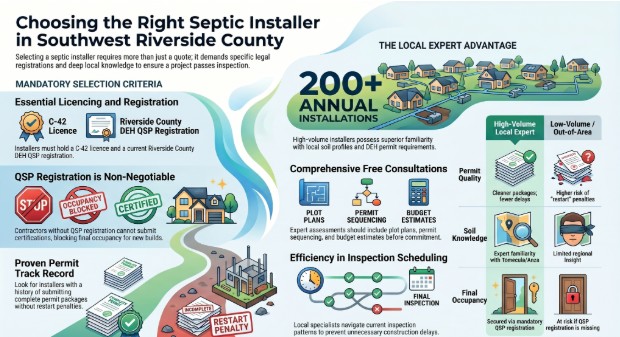
Choosing a septic installer for a new home in Temecula and Southwest Riverside County requires confirming an active C-42 license, a current Riverside County DEH QSP registration, documented experience with the specific system type required by the parcel’s percolation results, and a track record of submitting complete permit packages without restart penalties.
Contractors who lack QSP registration cannot submit OWTS certifications, which blocks final occupancy on any new build served by a private septic system.
Lanik Septic Service installs more than 200 complete septic systems per year across Southwest Riverside County — a volume that reflects active familiarity with Riverside County DEH permit requirements, local soil profiles across Temecula, Murrieta, Anza, Aguanga, and surrounding communities, and current inspection scheduling patterns.
High-volume local contractors submit cleaner permit packages and encounter fewer inspection delays than lower-volume operators working outside their primary service region.
Gordon Lanik personally conducts all on-site consultations at no charge — covering parcel assessment, preliminary system type recommendation, permit sequencing, and budget range.
Builders and owner-operators receive a detailed plot plan and cost estimate before committing to a contractor or finalizing a build schedule.
Homeowners planning new builds can also review septic system installation guides for a full overview of the process across Southwest Riverside County.
What permits are required for a new construction septic in Riverside County? New construction septic installation in Riverside County requires a percolation report signed by a registered Professional of Record, a scaled floor plan of all structures the system will serve, documentation of established water service, and a building permit from the local building and safety agency before the Riverside County DEH issues a construction permit.
How much does a new construction septic system cost in Riverside County? A conventional new-construction septic system in Riverside County costs $8,000–$20,000 to install. Alternative treatment systems run $15,000–$35,000, depending on soil conditions, system type, and parcel access. Permit fees and percolation testing add $1,500–$4,000 to the total project budget before installation work begins on the parcel.
How long does a new construction septic installation take in Riverside County? New construction septic installation in Riverside County generally takes four to eight weeks from permit submission to final inspection. Permit review generally runs two to four weeks. Excavation, installation, and county inspection add one to two weeks after permit issuance. Incomplete applications restart the review queue and significantly extend the timeline.
What is the difference between a conventional septic system and an ATU?
A conventional septic system moves wastewater through a tank and into a gravity-fed drain field where soil filters effluent. An alternative treatment system uses mechanical or biological treatment before dispersal and is required when soil percolation rates fail to meet Riverside County minimums. ATUs require an annual operating permit through the Riverside County DEH.
Why is a C-42 license required for septic installation in California?
California Business and Professions Code Section 7026 (2024) requires a C-42 sanitation systems contractor license for any septic work exceeding $500. The Riverside County DEH requires all OWTS construction permit applications to name a licensed C-42 contractor. The Riverside County DEH rejects applications naming unlicensed operators, and stop-work orders apply to any installation started without a valid permit.
What is a percolation test, and why is it required for new construction?
A percolation test measures the rate at which soil absorbs water on a given parcel to determine drain field sizing and system type. The Riverside County DEH requires percolation tests for all new construction OWTS applications, to be performed by a registered Professional of Record under the county’s LAMP (2022). Results determine whether a conventional or alternative treatment system is required.
Does Lanik Septic Service handle the full permit package for new construction?
Lanik Septic Service manages the complete permit submission package for new construction projects in Southwest Riverside County — including percolation coordination, OWTS plan preparation, and Riverside County DEH submission. Builders who delegate permit preparation to the installation contractor avoid penalties for incomplete applications and, on average, reduce the total project timeline.
What soil conditions require an ATU instead of a conventional system in Riverside County?
Soil conditions that prevent conventional septic system installation in Riverside County include slow percolation rates due to expansive clay soils, high groundwater tables, and restrictive subsurface layers that limit drain field depth. Parcels in portions of Anza, Mountain Center, and Aguanga frequently require ATU systems. A percolation report determines the requirement before permit submission.
How many septic systems does Lanik Septic Service install per year?
Lanik Septic Service installs more than 200 complete septic systems per year across Southwest Riverside County, portions of Northern San Diego County, and San Bernardino County. The firm also performs more than 1,000 residential certifications annually. Installation volume reflects active familiarity with Riverside County DEH permit requirements and local soil conditions across the service area.
What should builders verify before hiring a septic contractor in Riverside County?
Builders should verify an active C-42 license in good standing with the California Contractors State License Board, current QSP registration with the Riverside County DEH, documented experience with the system type required by the parcel’s percolation results, and proof of general liability and workers’ compensation insurance before awarding a septic subcontract on any Riverside County new construction project.
Can percolation testing begin before the building permit is issued?
Percolation testing can begin before the building permit is issued in Riverside County — the perc report is a prerequisite for the DEH construction permit, not a product of it. Builders who initiate percolation testing concurrently with building permit applications compress the overall project timeline and avoid the sequence delay of waiting for building permit approval before starting soils work.
What is an annual operating permit for an ATU in Riverside County?
An annual operating permit is a Riverside County DEH requirement for all alternative treatment systems installed in the county. The permit covers inspection and verification of the maintenance of the mechanical or biological treatment components. ATU owners must maintain the operating permit in good standing — a lapsed permit triggers a compliance notice from the Riverside County DEH and can affect property transfer certification.
A permit delay or an unlicensed subcontractor can set your new build back weeks and cost thousands in restart fees. Lock in your septic installation contractor with Lanik Septic Service early — Southwest Riverside County’s C-42 licensed installer.
Reviews
“This company is BEYOND helpful. Great customer service in the office, hard working employees in the field, reliable and very trust worthy. Having to replace an entire septic system is not something we ever intended on doing, but had to. If it hadn't been for Lanik Enterprises, Inc, I don't know where we would be. I HIGHLY RECOMMEND Lanik Enterprises!”
- Chanel Leos
