

License A & C-42 #458947

Originally published: September 2026
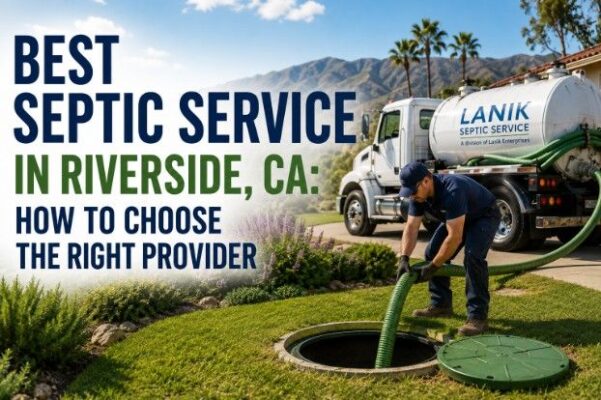
Choosing a septic service provider in Riverside, CA comes down to five verifiable factors: an active C-42 license, the right registration for the specific task (percolation testing, OWTS certification, or ATU service), in-house permit processing, written pricing, and a documented labor warranty.
A Riverside septic services provider without the correct Riverside County DEH registration can’t legally sign off on the paperwork a permit or certification requires.
Homeowners can verify a contractor’s license status directly through CSLB’s license search tool before signing a contract. Reviews matter, but licensing and registration determine whether the work is legal.
Riverside homeowners comparing septic providers can request a written estimate from Lanik Septic Service before committing to a contract.
Contracting without a license above the legal threshold isn’t just a paperwork problem — it’s a criminal misdemeanor under Business and Professions Code §7028, and CSLB has run enforcement stings against unlicensed contractors in Riverside County before.
Beyond the legal exposure, hiring the wrong registration for the job — a contractor without QSP standing signing off on an OWTS certification, for instance — produces paperwork the county won’t accept, which shows up as a rejected permit or a stalled real estate transaction.
That risk often shows up at the worst possible time—during a home sale, when a septic certification is due, or partway through a repair when a submission gets rejected for missing the right registration.
If you’re ready to get started, call us now!
A C-42 Sanitation System Contractor license, issued by the California Contractors State License Board, is the classification required to fabricate and install septic tanks, drain fields, and related sewage-disposal structures.
California law (BPC §7048) exempts only very small jobs — under $1,000 total, requiring no building permit, done by one person with no employees — from this requirement; nearly all septic work falls outside that exemption.
| What to Verify | Why It Matters | Where to Check |
| Active C-42 license | Confirms legal authority to perform septic work | CSLB license search |
| General liability insurance | Covers property damage during excavation or installation | Ask the contractor directly; CSLB search shows bond status |
| Workers’ compensation coverage | Protects the homeowner from liability if a worker is injured on-site | Ask the contractor directly |
| Riverside County DEH registration matching the task (PR or QSP) | Required to sign percolation reports or OWTS certifications | Riverside County DEH |
A CSLB search takes about two minutes and shows license status, classification, expiration date, and bond information using either the license number or business name.
These are two separate registrations, and Riverside County DEH’s guidance draws the line clearly: a percolation report must be signed by a registered Professional of Record (PR)—typically a civil engineer, geologist, or registered environmental health specialist.
An OWTS certification, by contrast, can be signed by either a QSP or a PR. ATU service agreements are specifically a QSP function.
In practice, this means a contractor doing a straightforward tank certification for a home sale needs QSP or PR standing, while new construction or a system relocation involving a percolation test needs a registered PR specifically.
Asking which registration applies to the exact task—not just “are you registered”—prevents a submission from being rejected for the wrong signature.
If you’re ready to get started, call us now!
Reviews and reputation answer a narrower question than licensing does — they show how a company treats customers, not whether the work is legal.
A BBB rating, years in business, and the share of repeat customers a company reports are reasonable indicators worth checking alongside licensing status.
A contractor with a long-standing BBB Accredited Business rating and a documented history of repeat customers has more to lose from cutting corners than a company with no track record in the area.
A written, itemized estimate is one of the clearest signals of a transparent contractor. The estimate should name the specific service — pumping, repair, or installation — along with tank size, access conditions, and any add-on fees like tank locating, before work begins.
A verbal-only quote, or a number that changes significantly once the crew arrives, is a reasonable basis for requesting a second bid.
A written labor warranty on repairs and installations, and a separate warranty period on septic certifications, gives a homeowner recourse if a problem shows up shortly after the work is done.
Ask what the warranty covers, how long it lasts, and whether it’s documented in writing rather than described verbally.
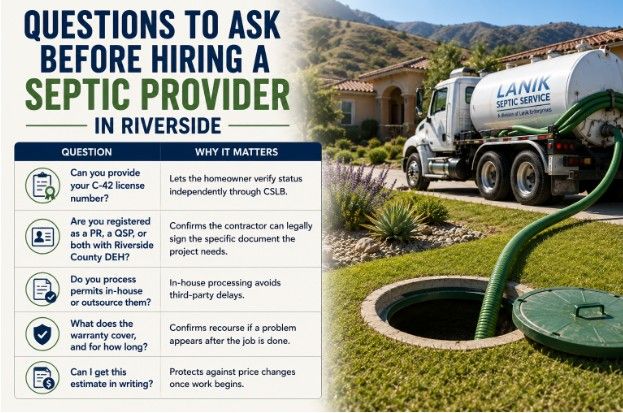
| Question | Why It Matters |
| Can you provide your C-42 license number? | Lets the homeowner verify status independently through CSLB |
| Are you registered as a PR, a QSP, or both with Riverside County DEH? | Confirms the contractor can legally sign the specific document the project needs |
| Do you process permits in-house or outsource them? | In-house processing avoids third-party delays |
| What does the warranty cover, and for how long? | Confirms recourse if a problem appears after the job is done |
| Can I get this estimate in writing? | Protects against price changes once work begins |
Choosing a septic provider in Riverside without checking these factors risks a rejected submission or a warranty that doesn’t exist. Contact Lanik Septic Service for a written estimate and registration details before scheduling work.
How do I verify a septic contractor’s license in Riverside, CA? CSLB’s online license search tool lets homeowners check a contractor’s license status, classification, expiration date, and bond information using either the license number or business name. The search takes about two minutes and doesn’t require an account.
What does C-42 licensed mean? C-42 is the California Contractors State License Board classification required to fabricate and install septic tanks, drain fields, and related sewage-disposal structures. Nearly all septic jobs require it; the only exemption covers work under $1,000 that needs no permit and no hired help.
What’s the difference between a QSP and a Professional of Record? A Professional of Record (PR) signs percolation reports for Riverside County. Either a QSP or a PR can sign an OWTS certification, while ATU service agreements are specifically a QSP function—the two registrations aren’t interchangeable for every task.
Is it legal to hire an unlicensed septic contractor in Riverside County? No. Contracting without a license above the legal threshold is a misdemeanor under Business and Professions Code §7028, and CSLB has conducted enforcement stings against unlicensed contractors in Riverside County. Hiring an unlicensed contractor also removes legal recourse if the work fails.
What should be included in a septic service written estimate? A written estimate should name the specific service, tank size, access conditions, and any add-on fees such as tank locating, before work begins. A verbal-only quote or one that changes significantly on arrival is a reason to request a second bid.
Does a septic company need to handle permits in-house? Not legally, but in-house permit processing avoids delays from outsourcing paperwork to a third party. A contractor who handles percolation reports, permits, and certifications directly typically moves a project through Riverside County DEH review faster.
What warranty should a septic repair or installation include? A written labor warranty covering repairs and installations, and a separate warranty period for septic certifications, gives a homeowner recourse if a problem appears shortly after the work is done. Ask for the warranty terms in writing, not verbally.
How do I check a septic company’s reviews and reputation? BBB accreditation status, years in business, and Google reviews are reasonable starting points, though they answer a narrower question than licensing does. Reviews show service quality; only a CSLB and DEH registration check confirms the contractor is legally qualified to do the specific work.
What’s the difference between a septic pumping company and a full-service contractor? A pumping-only company handles routine tank service but may not hold the C-42 license or DEH registration needed for repairs, installations, or certifications. A full-service contractor covers pumping, repair, installation, and permit processing under one license.
What red flags suggest a septic contractor should be avoided? Refusing to provide a license number, offering only a verbal quote with no written estimate, not mentioning a labor warranty, or being unable to say which Riverside County DEH registration applies to the job are all reasons to get a second bid before hiring.
Reviews
“This company is BEYOND helpful. Great customer service in the office, hard working employees in the field, reliable and very trust worthy. Having to replace an entire septic system is not something we ever intended on doing, but had to. If it hadn't been for Lanik Enterprises, Inc, I don't know where we would be. I HIGHLY RECOMMEND Lanik Enterprises!”
- Chanel Leos
